Device records drift
OLT, ONU and subscriber records can fall out of sync when inventory and service changes live in separate tools.
See how an FTTH team can connect OLT and ONU operations, subscriber lifecycle, billing and incident response in one controlled workflow.
This scenario is designed for an FTTH operator managing subscriber growth across one or more OLT vendors while network, field, support and billing teams need the same service context.
Important: this is a deployment playbook, not a named customer case study. The outcomes below are targets to validate in your environment, not measured customer results.
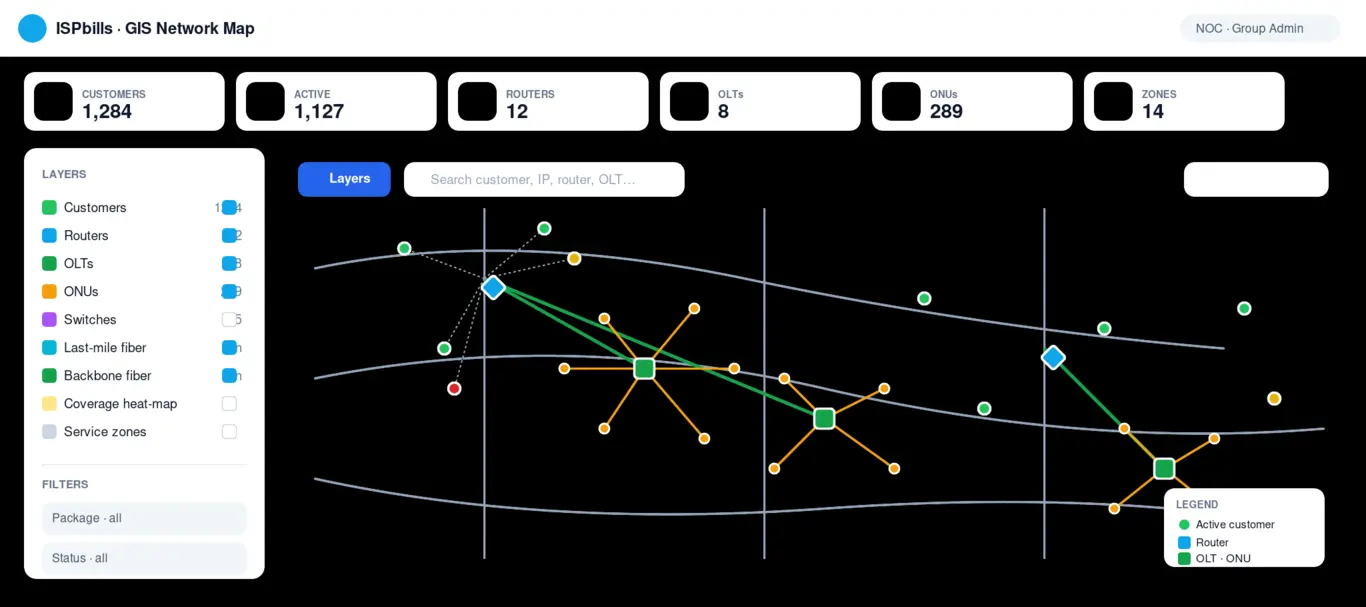
These are the handoffs the deployment should make visible and repeatable.
OLT, ONU and subscriber records can fall out of sync when inventory and service changes live in separate tools.
Manual device steps create avoidable differences between new installations, replacements and plan changes.
Support and field teams lose time assembling topology, optical and subscriber history before they can isolate a fault.
A subscriber record becomes the shared operational thread: the assigned ONU and OLT, service plan, billing state, location and support history stay available to the teams responsible for the service.
Move each service through a visible lifecycle, with clear ownership from network discovery to ongoing support.
Register OLT and ONU context, then connect network inventory with subscriber and location records.
Use supported provisioning workflows and repeatable plan settings for activations, replacements and changes.
Keep subscriber service state and billing actions visible in the same operational flow.
Review topology, device diagnostics and subscriber history before dispatching or changing the service.
The playbook is based on these existing ISPbills capabilities. Your exact device actions depend on the supported model and deployment configuration.
Discover supported devices and manage provisioning tasks from a shared operator console.
Relate subscribers, routers and OLT infrastructure to the places where service is delivered.
Bring supported device and optical signals into the investigation workflow.
Connect plan, invoice and service status so teams can see commercial and network context together.
Limit sensitive actions by role and retain accountability for operational changes.
Keep incident handling connected to the subscriber and service record.
Prove the full service path on controlled records before increasing device, subscriber or team scope.
Document OLT models, ONU inventory, plan rules, subscriber identifiers and team ownership before configuration begins.
Test discovery, activation, plan change, suspension and fault handling on a controlled group before wider use.
Reconcile imported records, restrict high-risk permissions and define who approves each production change.
Track failed actions, mismatched inventory and repeat incidents; refine the runbook before expanding scope.
Set a baseline before rollout, define an owner for each target and validate the change with your own operational data.
Technicians follow the same verified service path instead of rebuilding each activation from memory.
Support begins with subscriber, topology and device context already connected.
Network, field, support and billing teams work from a shared service record.
Roles and operational records make sensitive actions easier to review.
No. It is an illustrative deployment scenario based on ISPbills product capabilities. The outcomes are operational targets, not published customer measurements.
The operating pattern can be consistent, but available discovery, provisioning and diagnostics depend on the supported vendor, model and firmware. Confirm your device stack during deployment planning.
Include a representative OLT and ONU set, new activation, plan change, suspension, replacement and fault investigation. Reconcile every result before expanding the rollout.
Yes. A staged rollout can reduce risk. Define the source of truth and approval owner for each phase so service and billing state do not drift.
Bring your device stack, access model, subscriber lifecycle and team responsibilities. ISPbills can help map a controlled pilot around the workflow you run today.
Start a free trial today — no credit card, no commitment.