ONU identity is disconnected from the customer
Technicians need to know which device, port and service record belong together before they can activate or diagnose a line.
Bring OLT and ONU operations, optical diagnostics, subscriber plans and billing context together so teams can activate and troubleshoot fiber service with fewer handoffs.
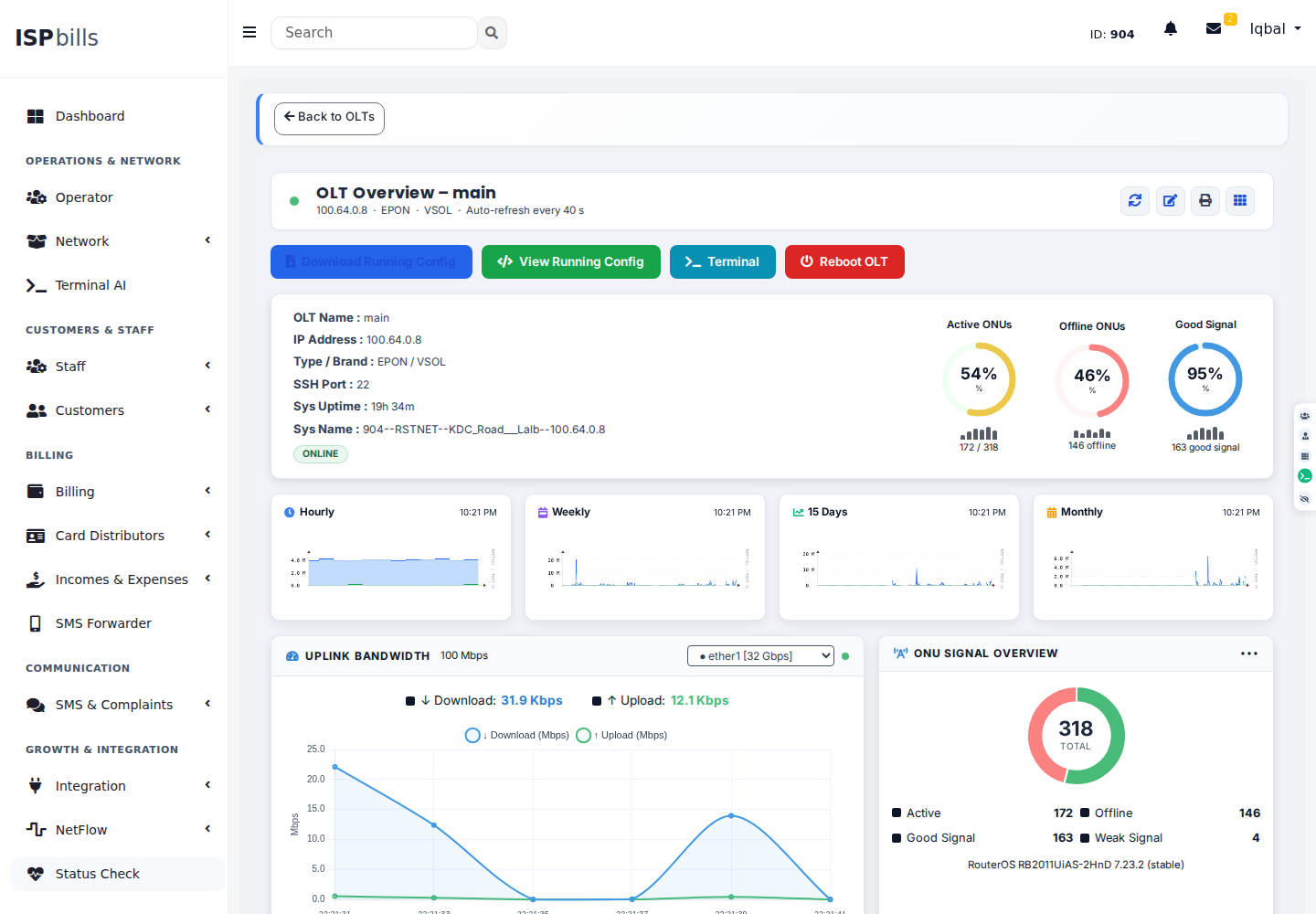
FTTH teams lose time when subscriber records, ONU identity, optical readings and billing status live in separate systems. A shared operational record makes each activation and fault easier to follow.
Technicians need to know which device, port and service record belong together before they can activate or diagnose a line.
Without signal context beside the subscriber, support must escalate issues before it can separate access faults from account questions.
As coverage expands, teams need geographic and topology context to understand where equipment and subscribers sit.
Keep the physical fiber endpoint, service plan and subscriber account connected from the moment an ONU appears through ongoing diagnostics.
Register supported OLT connections and organize the access infrastructure your operations team manages.
Surface discovered ONUs and associate the correct endpoint with the subscriber and service location.
Use the configured plan and provisioning workflow to move the subscriber from pending installation to active service.
Review link and optical information alongside account status when service quality changes.
Give engineers, support staff and billing teams a shared source of operational context.
Bring discovered subscriber endpoints into a controlled registration workflow.
Manage supported OLT connections and ONU service context from one console.
Visualize fiber coverage and network assets geographically.
Review available signal and link information while investigating service quality.
Run recurring plan billing alongside the subscriber service record.
Limit operational access according to team responsibility.
Keep the team in control by validating data, access rules and operational ownership before each stage goes live.
Record the OLTs, ONU models, profiles, locations and subscriber identifiers involved in the rollout.
Define how discovered endpoints are approved, associated and moved onto the correct subscriber service.
Pilot with a controlled service area and confirm provisioning, billing and optical troubleshooting before expansion.
Use a shared operating context to understand subscriber access, network health, support impact and billing state.
Practical answers for teams evaluating operational fit and planning a rollout.
Compatibility depends on the vendor, model and software version. Confirm the equipment in your network with the ISPbills team before planning a rollout.
The FTTH workflow is designed to associate the discovered endpoint and provisioning context with the relevant subscriber service record.
Available optical and link information can be reviewed from the operational workflow. The precise readings depend on what the connected equipment exposes.
Yes. A staged rollout lets the team verify equipment connectivity, ONU association, provisioning and billing on a controlled footprint first.
Start a free trial today — no credit card, no commitment.