Offline has many meanings
A failed login, expired session, billing restriction or network problem can look identical to the subscriber.
See how a fixed-wireless operator can give network, support and billing teams one workflow for access, device context and subscriber state.
This scenario fits a WISP operating MikroTik and RADIUS-based access across towers and sectors, where support needs to distinguish an authentication issue, a network issue and a billing restriction without guessing.
Important: this is a deployment playbook, not a named customer case study. The outcomes below are targets to validate in your environment, not measured customer results.
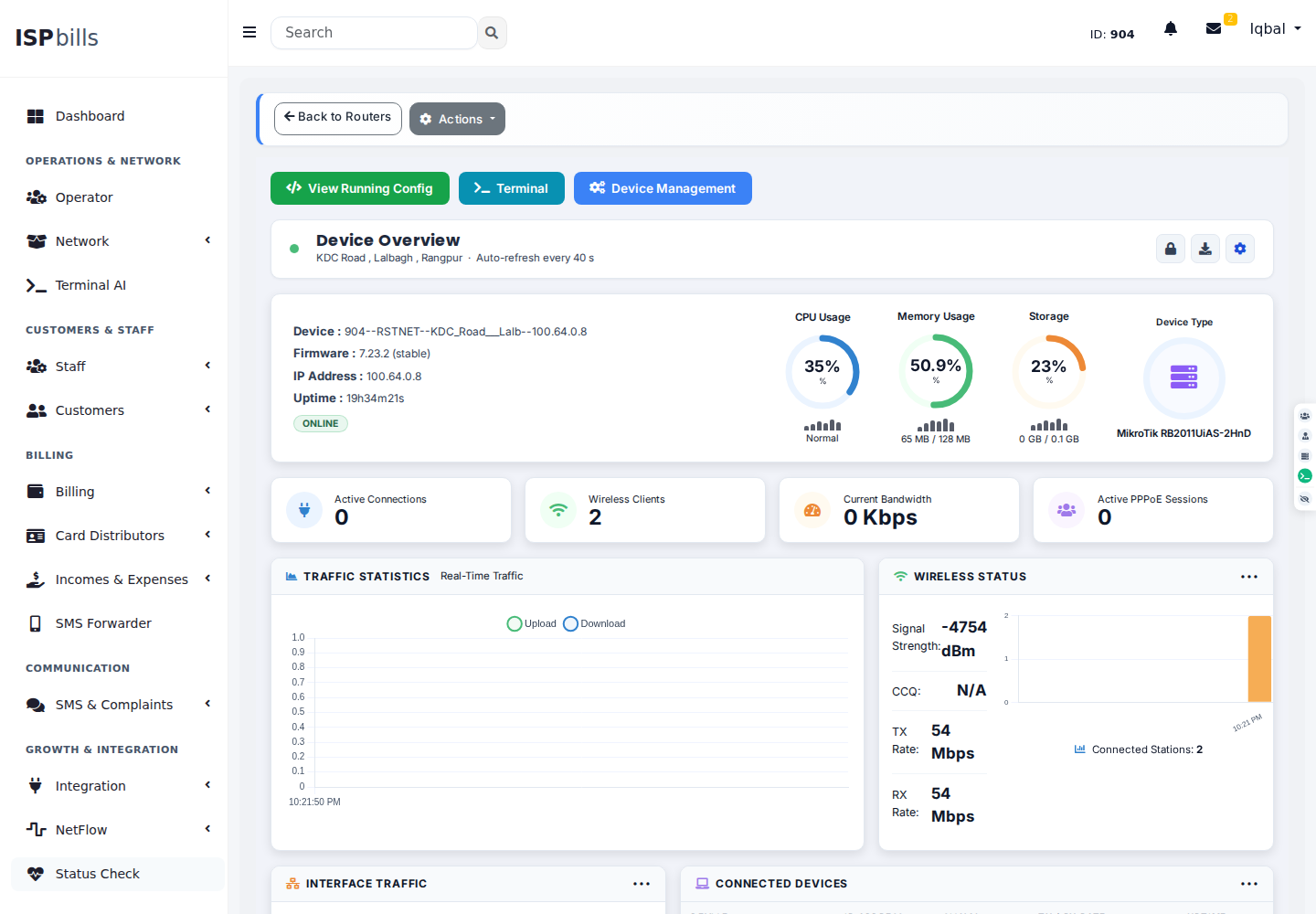
These are the handoffs the deployment should make visible and repeatable.
A failed login, expired session, billing restriction or network problem can look identical to the subscriber.
Tower, sector, signal and subscriber details are harder to use when they sit outside the support workflow.
Manual account changes can leave the subscriber service state inconsistent with the commercial record.
Support can begin with the subscriber, session, billing and network context in view, while network teams retain control of routers, towers and sectors through role-scoped operations.
Make service state explainable from the tower edge to the subscriber account and the invoice.
Organise supported routers and fixed-wireless infrastructure with the context operators need to identify service impact.
Use RADIUS session and accounting context to understand authentication and active service state.
Coordinate billing actions and subscriber access so account state is visible and deliberate.
Give support subscriber, device and session context before a router change or field escalation.
These capabilities support the workflow without replacing RF planning or the judgement of your network engineering team.
Monitor and manage supported routers through a consistent operational interface.
Expose authentication and session context that helps operators understand subscriber access.
Keep wireless infrastructure and service locations connected to operational records.
Use available signal and airtime context to support fixed-wireless investigation.
Keep commercial status available when staff review or change subscriber access.
Scope router and subscriber actions to the people responsible for them.
Prove the full service path on controlled records before increasing device, subscriber or team scope.
List routers, RADIUS realms, service plans, tower and sector ownership, and every manual enforcement rule.
Verify active, expired, suspended and restored service paths on a controlled subscriber group.
Introduce scoped roles, reconcile session data and keep rollback owners available during the transition.
Use support and session patterns to refine runbooks for authentication, billing and wireless incidents.
Set a baseline before rollout, define an owner for each target and validate the change with your own operational data.
Support can separate authentication, billing and network conditions before escalating.
Subscriber lifecycle rules replace one-off access changes where the deployment supports them.
Role scope and shared context reduce unnecessary high-risk changes.
Recurring session and infrastructure patterns become easier to recognise.
No. This is an illustrative operating playbook. Its outcomes are deployment targets and have not been presented as measured results from a specific customer.
No. ISPbills brings supported tower, sector, router, subscriber and service context into ISP operations; specialist RF design and engineering work remain part of the WISP stack.
Test authentication, accounting, plan assignment, suspension, restoration and failure handling with controlled accounts. Confirm rollback ownership before production cutover.
Yes. Observing and reconciling router, session and subscriber state first can establish a safer baseline for later lifecycle automation.
Bring your device stack, access model, subscriber lifecycle and team responsibilities. ISPbills can help map a controlled pilot around the workflow you run today.
Start a free trial today — no credit card, no commitment.