ISP accounting and reporting
ISP Accounting Software Connected to Subscriber Billing
Keep invoices, payments, expenses, journals and operating reports connected to the subscriber billing workflow. ISPbills provides an operational accounting layer for ISP teams while preserving clear boundaries around statutory accounting requirements.
Inspect the working interface, then verify your exact environment.
This is a real ISPbills product capture, not a conceptual mockup. Interface access depends on role and configuration; integration behavior must be tested with the actual provider, device model, firmware and network path.
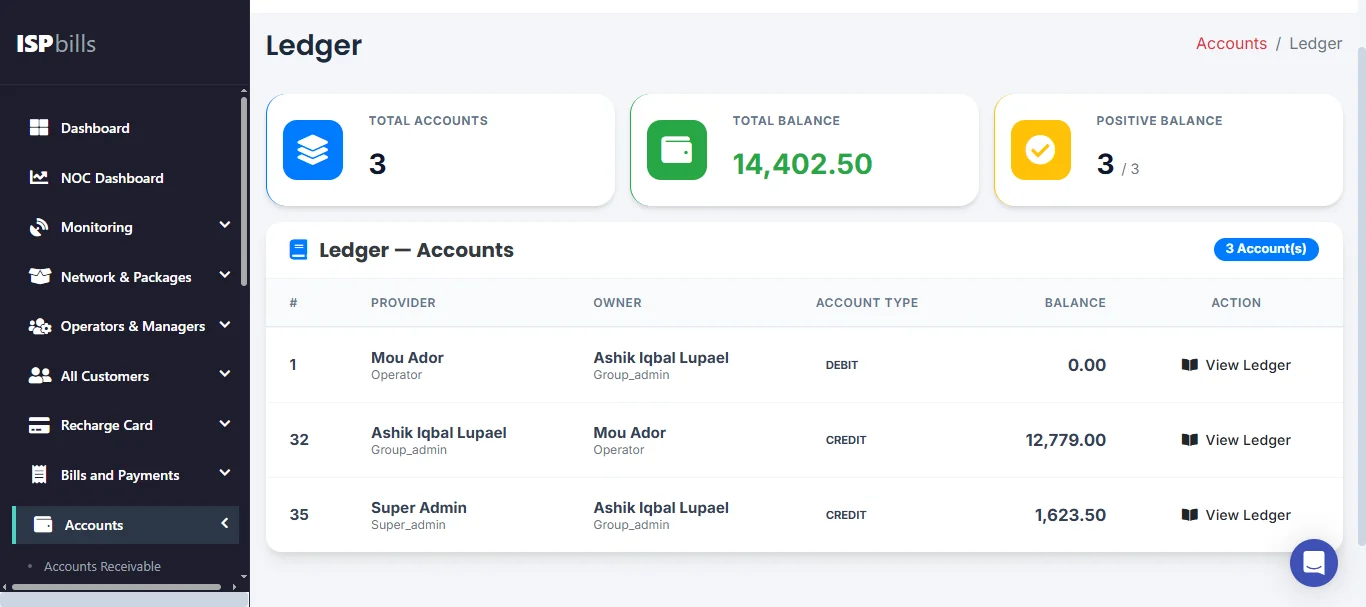
Revenue reporting starts with traceable billing and collection events.
When invoices, gateway references, cash collections and adjustments live in separate systems, teams spend time reconciling rather than investigating exceptions. A connected ledger improves traceability from subscriber charge to receipt.
Post subscriber charges
Generate invoices and retain customer, service, tax and due-date context.
Record collections
Apply verified online or staff-recorded payments with references and ownership.
Classify financial activity
Use supported accounts, journals, expenses and adjustments to retain an audit trail.
Review exceptions
Investigate balances, overdue accounts, collection performance and reconciliation gaps.
Capabilities connected to the operating workflow
Use these as evaluation areas, then confirm the exact device, provider, version and commercial requirements that apply to your deployment.
Customer ledger
Review charges, payments, adjustments and outstanding balance by subscriber.
Accounts and journals
Record supported double-entry transactions and maintain chart-of-account context.
Expenses
Capture operating expense records and supporting classifications.
Collection reports
Analyze invoices, receipts, overdue balances and payment-channel activity.
Audit history
Keep references and operator context around material financial changes.
Export and integration
Use supported reporting and API paths for downstream finance processes.
Operational accounting does not replace local professional advice.
Confirm the current product behavior in a representative environment. Public pages describe the operating model; implementation documentation and a controlled pilot establish the exact fit.
- Chart designMap accounts, taxes, currencies and reporting periods to the organization’s actual requirements.
- ReconciliationDefine ownership for gateway settlement, cash control, reversals, write-offs and month-end review.
- ComplianceConfirm statutory books, filing, retention and audit requirements with qualified local advisers.
Product, evidence and implementation paths
Answers for evaluation and implementation
Does ISPbills include double-entry accounting?
ISPbills provides supported account, journal, ledger, expense and reporting workflows connected to subscriber billing.
Can ISPbills replace a statutory accounting system?
That depends on local law and organizational requirements. Treat ISPbills as an ISP operational accounting layer and validate statutory needs with a qualified adviser.
Can payments be traced to invoices?
Yes. Supported payment workflows retain customer, invoice, amount and provider or operator reference context for reconciliation.
Bring the devices, billing rules and integrations your ISP actually uses.
Use the online workspace for product exploration, or ask the team to scope migration and compatibility questions.