Subscriber-aware observabilityUpdated October 2026
ISP Network Monitoring Software with Subscriber Context
Monitor routers, OLTs, links and service signals while keeping the affected subscriber, site and support context nearby. ISPbills brings device health, traffic and alarms into the same operating platform as billing and customer management.
- Router, OLT and service monitoring
- NOC dashboards and alert context
- NetFlow, sFlow and IPFIX visibility
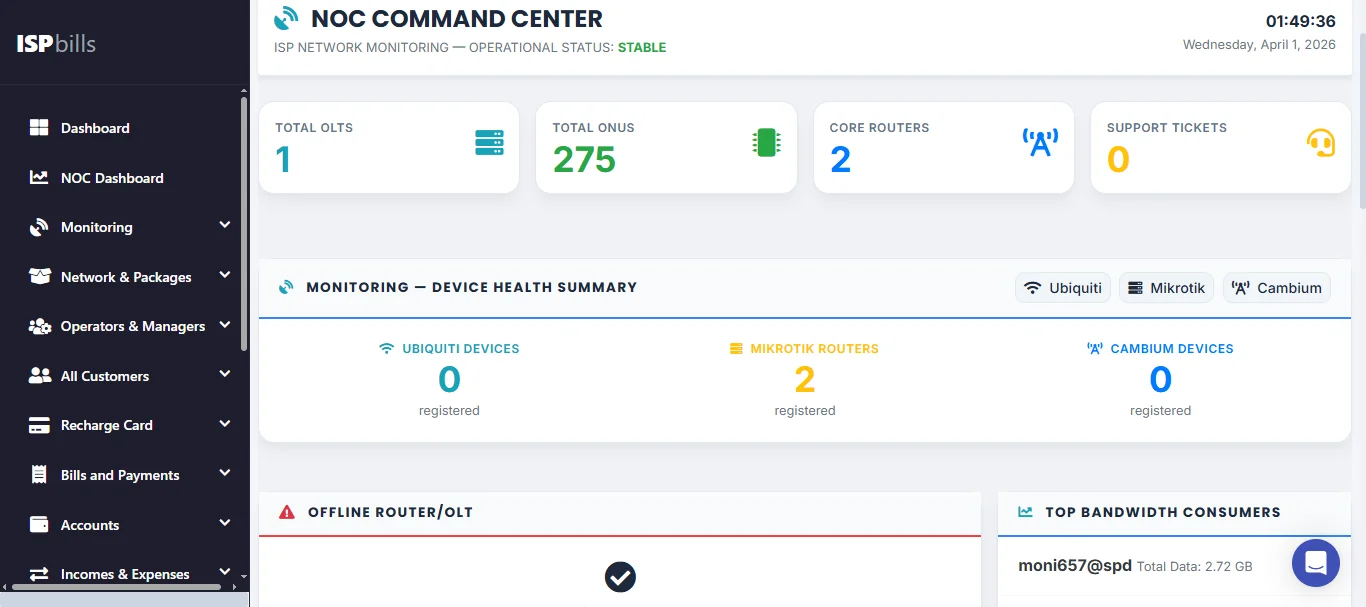
Availability alone does not explain customer impact.
A red device icon starts an investigation; it does not finish one. Operators need topology, interface, traffic, subscriber and recent-change context to decide whether an alarm is isolated, widespread or customer-affecting.
Inventory monitored systems
Define devices, sites, links, access equipment and expected ownership.
Collect health and traffic
Use supported polling, telemetry and flow sources with clear freshness and failure state.
Correlate impact
Relate alarms to interfaces, topology, subscribers, tickets and recent operational changes.
Respond with controls
Keep diagnosis separate from approved configuration or mitigation actions and retain an audit trail.
Everything this workflow needs—without losing the boundaries.
Capabilities shown here are implemented product areas. Device, provider and protocol behavior still depends on the selected integration and environment.
NOC dashboards
Review reachability, device health, latency, alarms and current operational status.
MikroTik visibility
Inspect RouterOS resources, interfaces, wireless clients and live bandwidth.
Fiber monitoring
Bring supported OLT, ONU, PON and optical state into the same operating view.
Flow telemetry
Analyze supported NetFlow, sFlow and IPFIX sources for traffic and security context.
Status communication
Publish service information and keep support paths clear during an incident.
Subscriber impact
Use the shared operating record to identify which services and customers may be affected.
A green ping is not a complete service-health model.
Reachability, protocol checks, device telemetry and flow data answer different questions. ISPbills brings them together with topology and subscriber context while keeping data freshness visible.
Read implementation documentation →Active checks
Run ping, TCP, HTTP, DNS, SSL and SNMP checks with explicit intervals, timeouts and incident state.
Device and flow telemetry
Inspect RouterOS and fiber context, RRD history, and supported NetFlow, sFlow or IPFIX sources.
Operational response
Connect alarms to affected services, current tickets, ownership and controlled response workflows.
Monitor the service signal—not only the box.
Native checks cover ICMP reachability, TCP ports, HTTP responses, DNS resolution, SSL state and SNMP. Zabbix hosts and unresolved problems can be synchronized into the same operating environment.
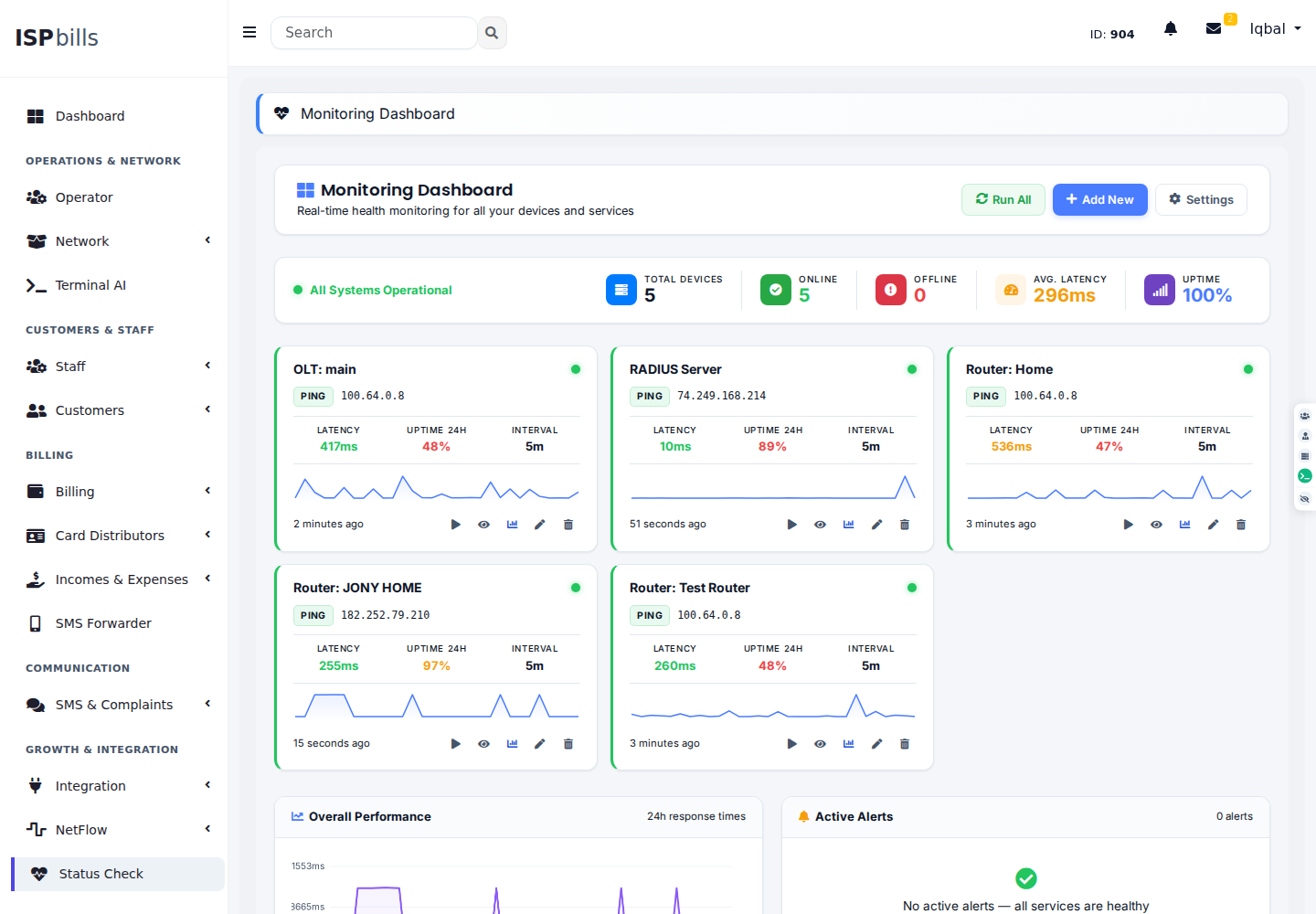
Monitoring quality depends on an explicit data and response model.
Public product information describes the current operating model. A controlled pilot proves the exact fit for your data, devices, providers and failure cases.
- 01CoverageDefine which devices, links, signals and service checks are authoritative for each site.
- 02FreshnessMake collection intervals, timeouts, missing data and stale telemetry visible to operators.
- 03EscalationAssign alarm ownership, severity, communication and change approval before an incident occurs.
Straight answers before you deploy.
Need a model-, provider- or migration-specific answer? Bring the exact environment to the team.
What can ISPbills monitor?
ISPbills provides supported monitoring for routers, OLTs, ONUs, interfaces, links, traffic and service checks. Exact telemetry depends on device and integration compatibility.
Does monitoring connect to customer records?
Yes. The platform is designed to retain subscriber, service, access and network context within one operating environment.
Does ISPbills collect flow telemetry?
Supported sources include NetFlow, sFlow and IPFIX. Collection and retention should be sized for the ISP traffic and investigation requirements.
See how ISPbills fits the network you already run.
Explore the current product, then scope compatibility and migration with your actual devices, billing rules and integrations.