ISP software research
ISP Billing Software Comparison & Alternatives 2026
Compare ISP billing and operations platforms using public product evidence, explicit unknowns and a repeatable evaluation method. These vendor-authored comparisons are research aids—not independent rankings or claims that one product is universally best.
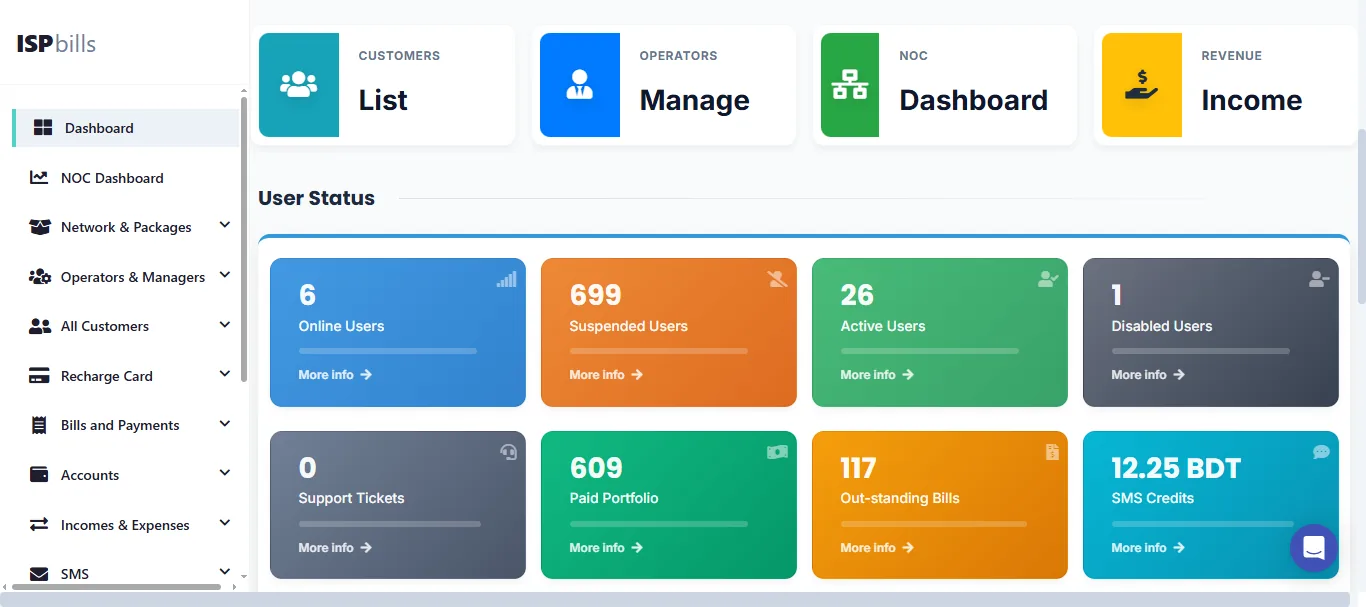
Inspect the working interface, then verify your exact environment.
This is a real ISPbills product capture, not a conceptual mockup. Interface access depends on role and configuration; integration behavior must be tested with the actual provider, device model, firmware and network path.
The right platform depends on the network, market and operating responsibility.
A feature checklist cannot establish implementation quality, support fit or total operating cost. Use these comparisons to form questions, then validate current functionality, pricing, data portability and required integrations directly with each vendor.
Define requirements
List billing rules, network vendors, AAA, payments, reporting, deployment and support obligations.
Collect public evidence
Use current official documentation and identify every item that still requires vendor confirmation.
Run a representative pilot
Test real workflows with representative devices, packages, payment events and operator roles.
Plan data portability
Export sample records, map identifiers and prove rollback before committing to migration.
Capabilities connected to the operating workflow
Use these as evaluation areas, then confirm the exact device, provider, version and commercial requirements that apply to your deployment.
Splynx
Compare billing, RADIUS, MikroTik, deployment, OLT operations and regional integrations.
Open comparisonSonar Software
Compare subscriber management, billing, provisioning, API and operating-market fit.
Open comparisonUISP CRM / UCRM
Compare Ubiquiti-centered workflows with vendor-neutral billing and network operations.
Open comparisonPowercode Command
Compare billing, network product scope, IPv6, fiber and migration requirements.
Open comparisonVisp
Review an established WISP billing and operations approach against mixed-network needs.
Open comparisonAzotel SIMPLer
Compare packaged WISP deployment with an extensible ISP operating layer.
Open comparisoniBilling
Compare RADIUS, MikroTik, regional payments, OLT operations, resellers and self-hosting.
Open comparisonSweet Billing
Compare Bangladesh billing, collections, customer portals, deployment and network depth.
Open comparisonZapify Billing
Separate available and roadmap capabilities across Bangladesh billing and network operations.
Open comparisonBD Net ISP
Compare local billing, bKash, SMS, reseller, RouterOS, RADIUS and fiber requirements.
Open comparisonISP Digital
Turn unavailable public detail into explicit demo and written-confirmation questions.
Open comparisonMaxim Billing
Use evidence requests and acceptance tests where public product documentation is unavailable.
Open comparisonMikroTik User Manager
Plan an evidence-led migration from AAA user management to connected ISP operations.
Open comparisonUse one evidence standard for every vendor, including ISPbills.
Confirm the current product behavior in a representative environment. Public pages describe the operating model; implementation documentation and a controlled pilot establish the exact fit.
- SourcePrefer current official documentation, published pricing and a reproducible live test over marketing summaries.
- UnknownMark unavailable public information as unknown; do not convert absence of evidence into a negative claim.
- DecisionRecord the version, date, test environment, result and owner for each requirement in the evaluation matrix.
Product, evidence and implementation paths
Answers for evaluation and implementation
Are these independent comparisons?
No. ISPbills publishes these comparisons. Each page links the public sources used, labels unknowns and recommends direct validation with every shortlisted vendor.
Does ISPbills always win the comparison?
No product is the right fit for every ISP. The pages identify documented differences and evaluation questions; your network, market, team and commercial requirements determine fit.
How should an ISP test billing software?
Use representative subscribers, billing rules, payment events, RADIUS attributes, routers, OLT models, roles and exports in a controlled pilot with acceptance and rollback criteria.
Bring the devices, billing rules and integrations your ISP actually uses.
Use the online workspace for product exploration, or ask the team to scope migration and compatibility questions.