Fiber access operationsUpdated October 2026
OLT & ONU Management Software for FTTH ISPs
Connect supported multi-vendor OLT discovery, ONU provisioning, optical diagnostics and PON context to subscriber billing and support. Teams can investigate a fiber service from the customer record through the access network.
- Multi-vendor OLT and ONU workflows
- Optical and PON operating context
- Billing, GIS and support connections
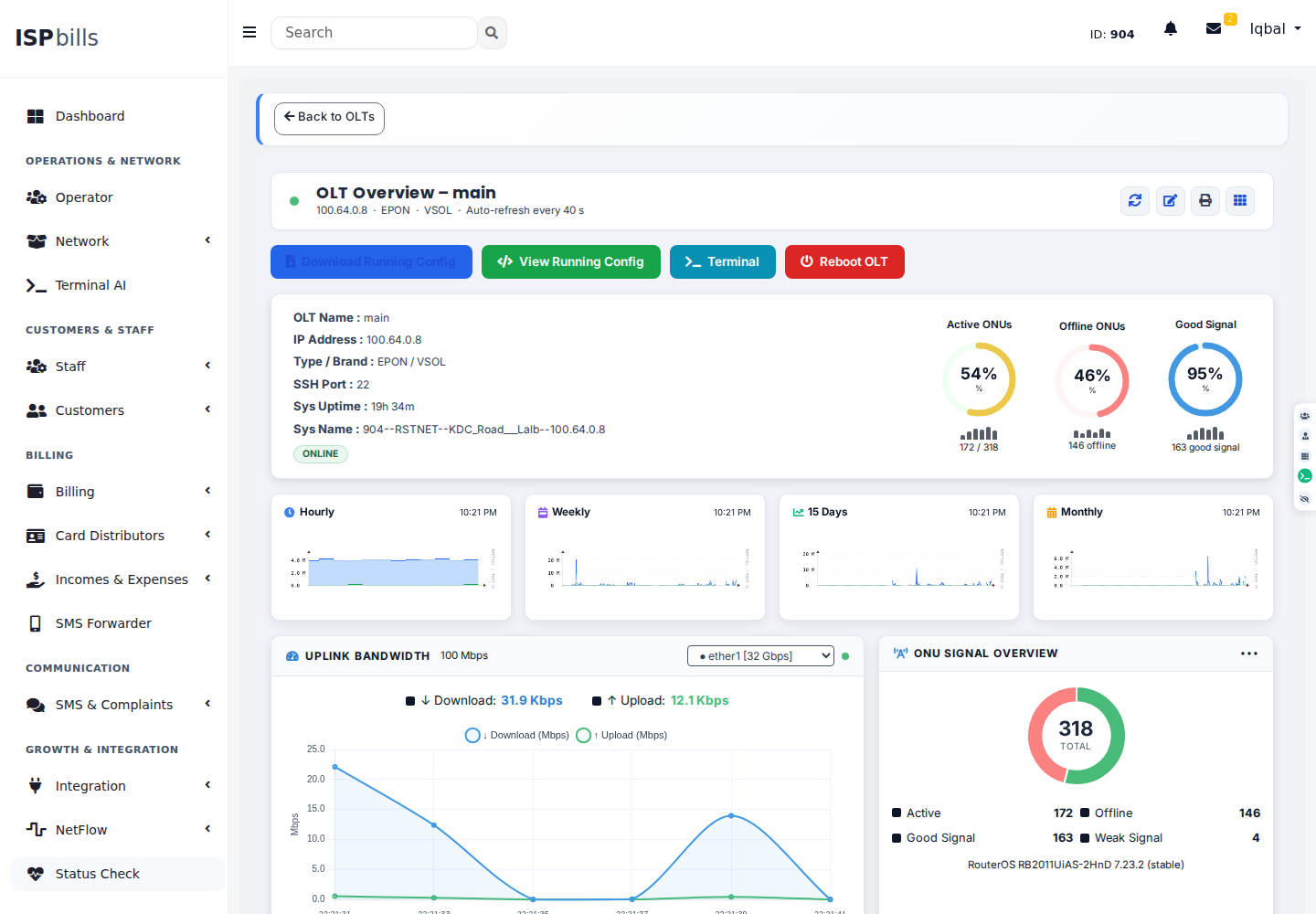
A fiber alarm is more useful when the affected subscribers are visible.
Standalone device consoles expose access hardware. Billing tools expose accounts. ISPbills joins supported OLT and ONU operations with subscriber, location, service and incident context so diagnosis does not begin with manual cross-referencing.
Connect a supported OLT
Record vendor, model, management path and protocol details, then verify read and provisioning capabilities.
Discover and identify the ONU
Review serial, board, PON position, state and available optical information before assignment.
Associate the subscriber
Link the access endpoint to the customer, service location, package and support record.
Monitor and diagnose
Use signal, status, topology and incident context to narrow a physical or service problem.
Everything this workflow needs—without losing the boundaries.
Capabilities shown here are implemented product areas. Device, provider and protocol behavior still depends on the selected integration and environment.
OLT inventory
Maintain supported devices, boards, slots, ports and management context.
ONU lifecycle
Discover, authorize, provision, associate and decommission supported ONUs.
Optical diagnostics
Review available Rx and Tx power, distance, status and loss-of-signal context.
Multi-vendor operations
Use a consistent workflow across supported Huawei, ZTE, BDCOM, VSOL and other drivers.
GIS and topology
Relate subscriber locations, fiber routes and access fanout to service records.
Billing connection
Keep fiber provisioning and service status aligned with the subscriber package and account.
Compatibility is a matrix, not a vendor-logo checklist.
Discovery, optical telemetry and write actions can differ by vendor, model, firmware, board and driver. ISPbills exposes that boundary so teams can validate read operations before provisioning.
Read implementation documentation →Discover and identify
Collect the ONU serial, state, PON location and available optical data through the selected device profile.
Associate the service
Link the endpoint to the subscriber, location, package and support record before authorizing changes.
Provision deliberately
Validate profiles, VLAN behavior and rollback on representative hardware before enabling approved write actions.
Honest support boundaries for multi-vendor fiber.
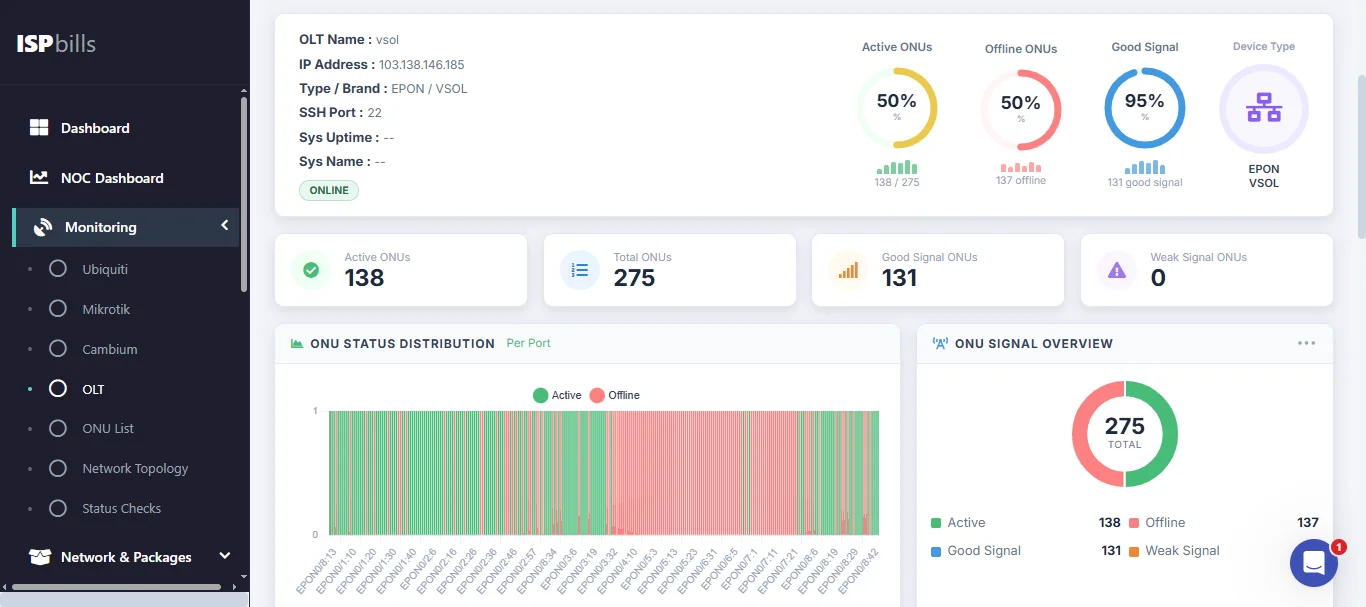
ISPbills currently defines 11 named vendor profiles plus a generic fallback. VSOL is marked hardware-verified; every other profile still requires model- and firmware-level validation.
Focused guides for the decisions behind the product.
Confirm exact vendor and firmware support before rollout.
Public product information describes the current operating model. A controlled pilot proves the exact fit for your data, devices, providers and failure cases.
- 01Compatibility matrixRecord vendor, model, firmware, boards and the exact discovery, telemetry and provisioning actions required.
- 02Read before writeBegin with inventory and monitoring, validate mappings, then introduce approved configuration changes.
- 03Field processDefine labeling, serial capture, splitter and location records so software state matches the physical plant.
Straight answers before you deploy.
Need a model-, provider- or migration-specific answer? Bring the exact environment to the team.
Which OLT vendors does ISPbills support?
ISPbills documents support for multiple vendors including Huawei, ZTE, BDCOM, VSOL, Fiberhome and others. Confirm the exact model, firmware and required operations before purchase.
Can ISPbills provision ONUs?
Yes, for supported vendor and model combinations. A pilot should verify discovery, authorization, service profiles, VLAN behavior and rollback.
Can support staff see optical power?
Available optical readings can be shown with subscriber and device context for supported equipment.
Does OLT management include billing?
The OLT itself does not bill customers. ISPbills connects supported fiber operations to subscriber packages, invoices, payments and service state.
See how ISPbills fits the network you already run.
Explore the current product, then scope compatibility and migration with your actual devices, billing rules and integrations.