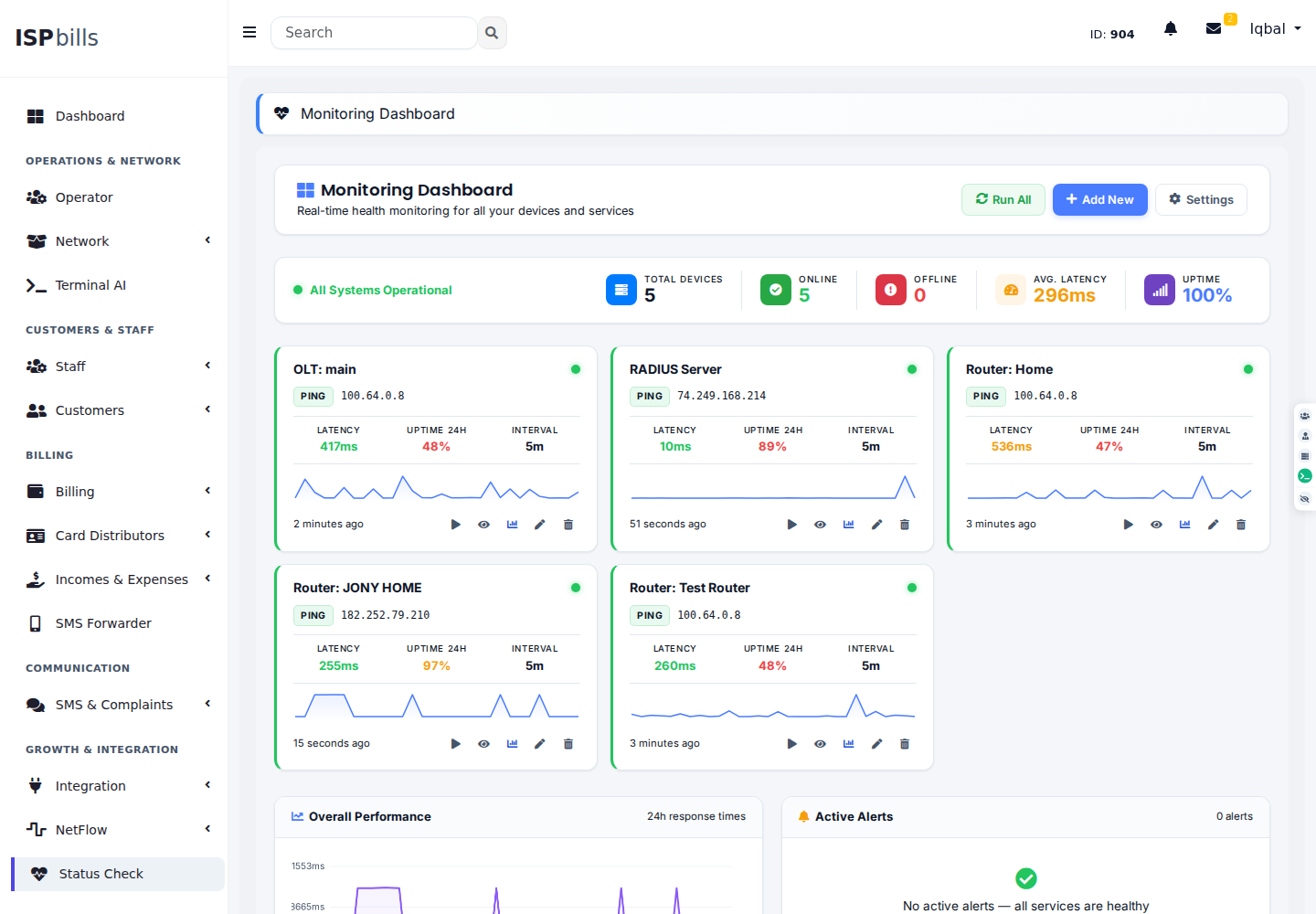
Network health
See every critical service at a glance
Track availability, latency and uptime from one clean operations dashboard.
Billing, subscribers, network operations and support — connected in one platform built for Internet Service Providers.
Real product screens for network teams, business operations and subscriber self-service.
Track availability, latency and uptime from one clean operations dashboard.
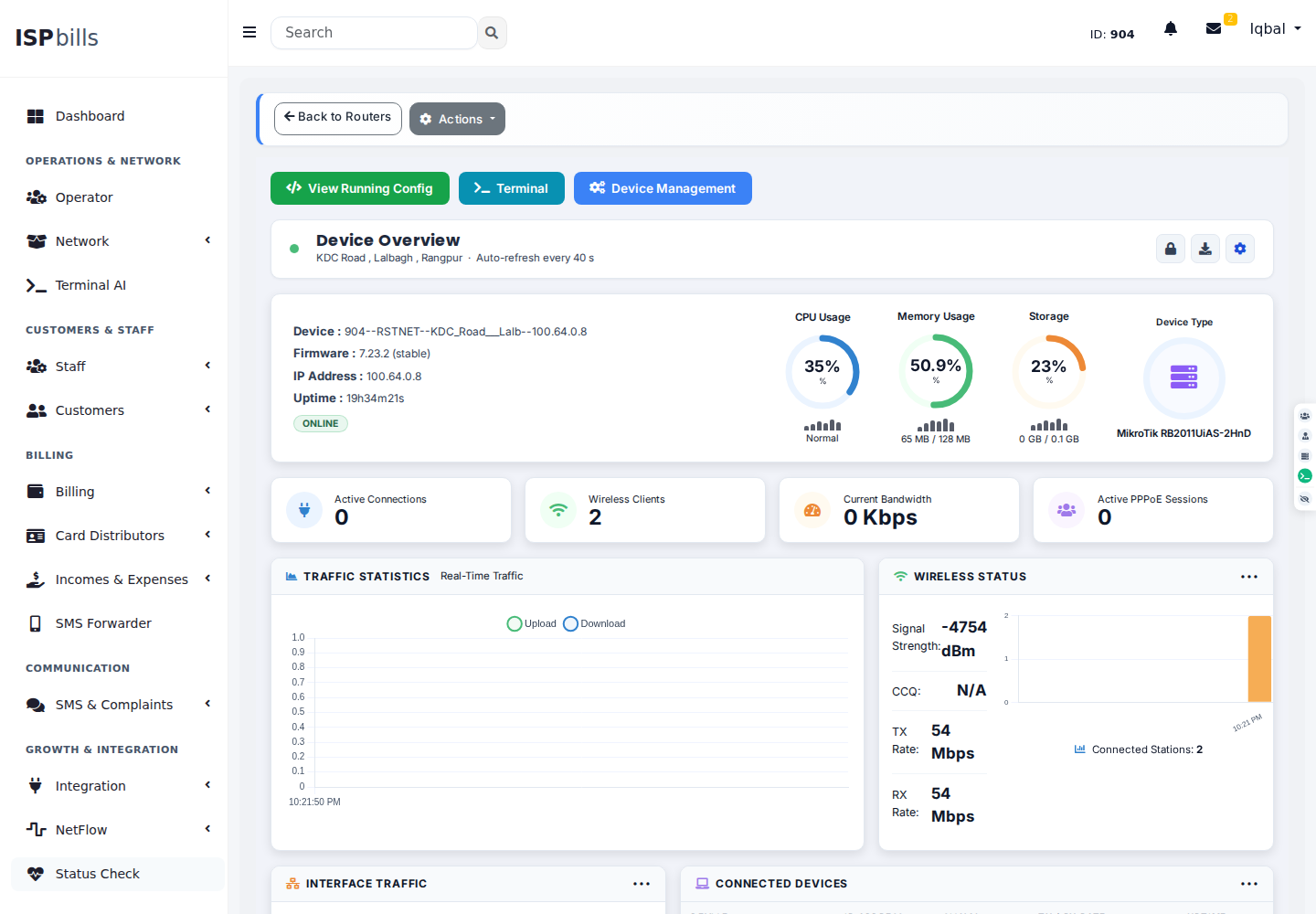
Monitor RouterOS resources, wireless clients, interfaces and live bandwidth without leaving ISPbills.
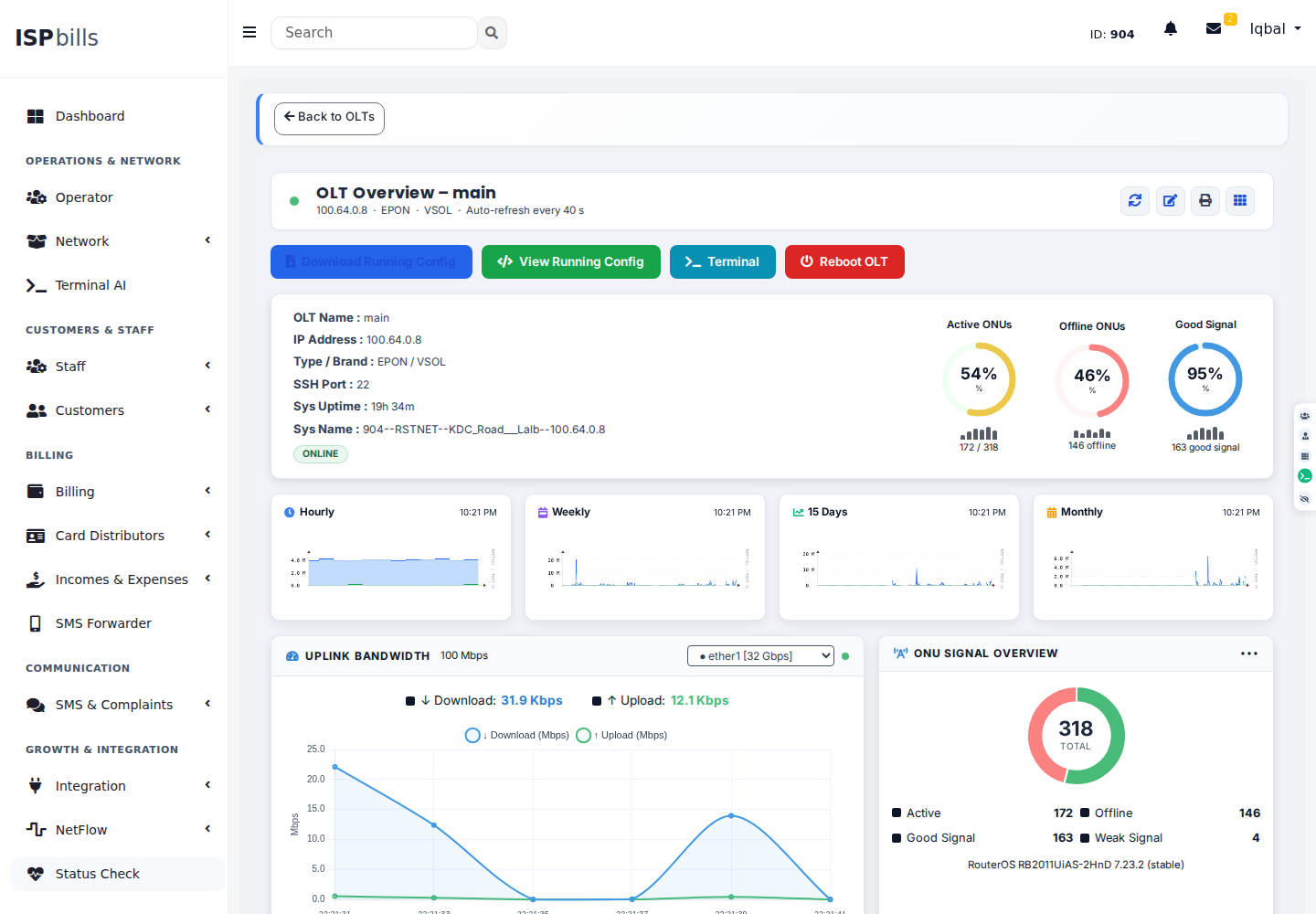
View online ONUs, signal quality, uplink traffic and performance trends from a live OLT workspace.
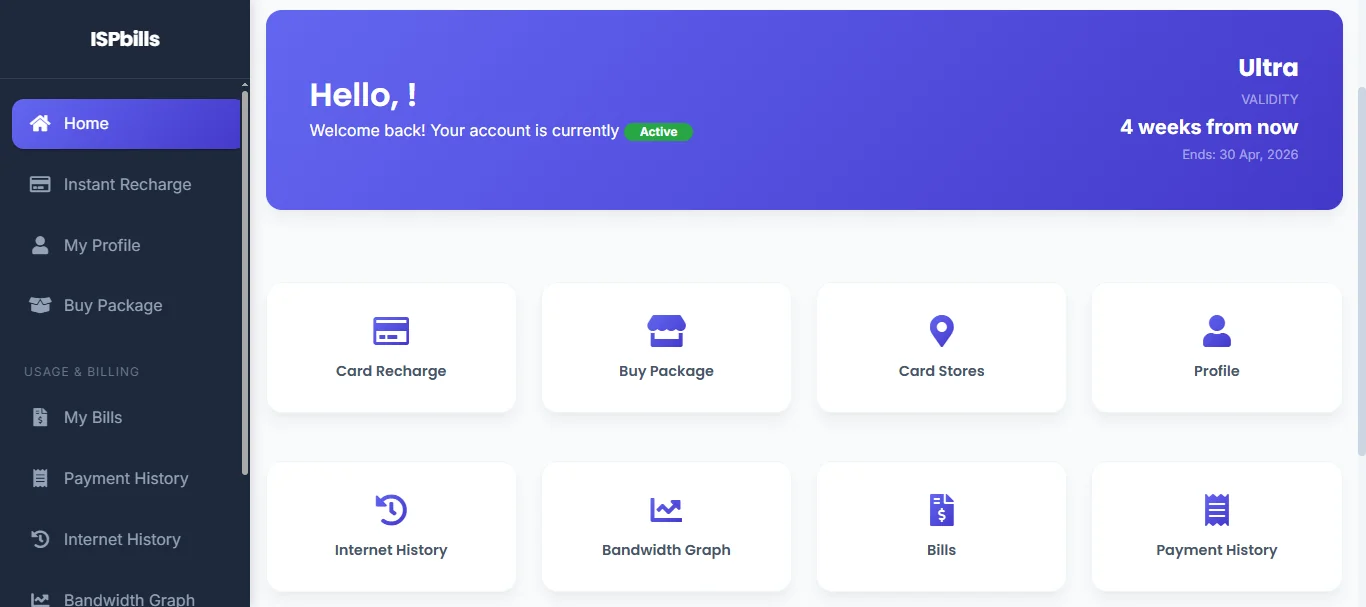
Offer a branded Portal where subscribers can review their service, pay bills online, download receipts and open support tickets from any device.
Explore Portal capabilitiesExplore 57 documented feature areas in 8 workflow groups, from initial setup to everyday operations and product guidance. Each area groups related workflows; individual screens and actions are not counted as separate modules. Availability depends on your role, plan, configuration and supported hardware.
Prepare your ISP workspace, business identity and existing subscriber records.
Identify unfinished setup before running daily operations, with checks tailored to the ISP and reseller hierarchy.
Maintain your ISP identity and local operating preferences without confusing subscriber-facing branding with the separate partner storefront product.
Move existing customer records into ISPbills and maintain subscriber groups with guided imports and bulk updates.
Organize customer records, verify registrations and define the services you sell.
Manage the complete customer lifecycle from registration to suspension through a unified 360-degree subscriber profile.
Choose supported registration-verification methods and review National ID submissions before granting access. This is an ISP review workflow, not a government identity-database lookup.
Build the service catalog that connects subscriber pricing to network speed, volume and validity controls.
Separate billing rules from speed packages so customer groups and resellers can use appropriate invoice and renewal policies.
Apply package-level data caps and reduced-speed policies to PPPoE subscribers who exceed their allowance, separate from package pricing and bulk migrations.
Control the available subscriber and reseller options from group-level settings rather than applying one fixed policy to every ISP.
Turn service plans into invoices, collect payments and reconcile your accounts.
Generate invoices automatically from subscriber packages, billing cycles and due dates with prepaid, postpaid, daily and monthly models.
Collect subscriber payments through 24 distinct external providers. Merchant setup and regional availability determine which methods can be offered.
Review supported merchant-wallet payment messages forwarded from registered Android devices and reconcile them with subscriber payments.
Use customer advance balances for supported self-service time purchases. Availability depends on ISP policy and a package with minute-based pricing.
Track offline collections and money handed over by staff alongside online payments, with separate receivable and settlement records.
Generate, distribute and reconcile scratch-card based prepaid recharges through a dedicated distributor portal.
Manage accounts, journals, ledgers, expenses and financial reports alongside ISP billing and collections.
Connect guests, support subscribers and keep customers and teams informed.
Give subscribers a branded, mobile-ready portal for bill payment, connection status, support tickets and account management.
Connect guests through a captive-portal journey that combines registration, mobile verification, package selection and device-bound access.
Run Wi-Fi advertising campaigns before internet access, with guest targeting, controlled playback and measurable engagement.
Give suspended subscribers a clear notice and payment path through an ISP-configured portal and supported MikroTik redirect rules.
End-to-end complaint management with categories, departments, priorities and SLA tracking, including customer self-service ticket creation.
Route staff and reseller issues through an internal ticket workflow, distinct from subscriber complaints and ISPbills platform-support conversations.
Connect to 37 registered SMS providers for subscriber messaging. Delivery requires an active provider account, valid credentials and an approved sender where required.
Reach subscribers through SMS, email, WhatsApp, Telegram and in-app messaging with automatic event-driven triggers.
Configure subscriber access and operate supported routers, fiber, wireless and VPN services.
Centralize authentication, authorization and accounting directly from the ISPbills administration panel.
Select the operator and apply the ISPbills RouterOS setup with one Configure Router action. Requires a reachable router, write-capable API credentials and existing Hotspot servers where needed; this is not a zero-touch factory setup.
Ask iPilot to configure supported OLTs, managed switches and MikroTik routers in plain language. Live changes require explicit operator approval, device-management permission and compatible access. Fleet checks remain read-only; disruptive actions need a reviewed plan.
Organize subscriber address space with IP pools, subnet checks and PPPoE profile assignments rather than maintaining separate spreadsheets.
Manage FTTH, GPON and EPON infrastructure across 11 named OLT profiles. Discovery, provisioning and telemetry depend on model, firmware and profile; not every profile is hardware-verified.
Maintain managed-switch records and inspect health over configured SNMP access. Available readings depend on the device model and firmware; AI configuration is covered separately.
Bring supported Ubiquiti and Cambium radios into the network workspace. Live readings require compatible device APIs and configured access.
Offer managed VPN services with server, address-pool, account and certificate provisioning from ISPbills.
Manage supported staff equipment logins centrally, separately from subscriber PPPoE and Hotspot authentication.
Maintain supported subscriber copies on a selected MikroTik router and manage the primary authenticator. This is not a full database backup or a guarantee of automatic failover.
Watch service health, investigate incidents and maintain the network map and configuration history.
Full-featured Network Operations Center with real-time device monitoring, traffic graphs, instant alerts and integrated Zabbix support.
Investigate attacks and coordinate scoped mitigation for protected networks. Requires an active plan or trial, configured telemetry and verified response connectors.
Keep location-based equipment records and review routers, OLTs, ONUs and other field equipment through inventory reports.
Plot subscribers, ONUs, routers, poles and cable routes on an interactive map with precise network and customer location data.
Trace logical device relationships to understand how subscribers connect through the access network. Geographic locations and cable routes are covered by GIS Network Mapping.
Keep versioned configuration snapshots for supported routers and OLTs so teams can inspect changes and prepare recovery.
Publish selected service checks and incident information to a public status page without exposing the internal monitoring workspace.
Delegate responsibilities, review business performance and investigate operational activity.
Role-focused dashboards combine administrative, NOC and business metrics with live widgets and exportable reports.
Prepare operational and regulatory reporting data from customer, payment and network records. Review exports against your current local filing requirements.
Give each ISP reseller a dedicated operator panel for subscriber business, assigned services and financial oversight. This panel is separate from the ISPbills platform-partner storefront.
Give downstream resellers their own sub-operator login under a parent reseller, with assigned billing profiles and an account-specific business dashboard.
Delegate operations to managers, NOC, accounts and support staff using role-specific workspaces and configurable permissions.
Offer supported password, authenticator, passkey and social sign-in journeys with separate staff and customer sessions.
Investigate access problems and operational changes through role-scoped authentication, device and activity histories.
Extend your workflows, work from Android, grow a partner business and find product guidance.
Give NOC engineers and administrators a plain-English workspace for subscriber queries, diagnostics and guided business actions. Device configuration is documented separately.
Build integrations through REST APIs, managed API clients and developer-ready reference material. Event delivery has its own Webhooks feature.
Send supported application events to your own systems instead of relying only on repeated API polling.
Use dedicated Android applications for administration, customer self-care and partner access. Screens and actions follow the signed-in account permissions.
Run a branded reseller-partner business for ISP clients, separate from the operator hierarchy that manages an ISP's own subscribers.
Manage your own ISPbills subscription, invoices and optional services from a commercial portal distinct from subscriber billing.
Refer other businesses to ISPbills and review attributed signups and commission records. Program eligibility and commission rules apply; this is not a subscriber loyalty scheme.
Find product guides from the public Help Center and in-app Help workspace, with direct paths from instructions to platform support.
Contact ISPbills from the platform support portal. The ISPbills support team uses an Intercom-connected inbox with configurable AI-assisted replies.
Explore 84 directory entries across payment and SMS providers, equipment profiles, communication channels and protocols.
Bring billing, subscribers, network operations and support into one production-ready platform.