Connected ISP operationsUpdated October 2026
ISP Billing Software for Broadband, Fiber & Wireless ISPs
Automate recurring invoices, payment reconciliation, subscriber access and network operations from one accountable system. ISPbills connects the commercial record to RADIUS, MikroTik, OLT and support workflows instead of leaving teams to reconcile separate tools.
- Free for up to 100 active subscribers
- Managed cloud or supported self-hosting
- MikroTik, FreeRADIUS and multi-vendor OLT support
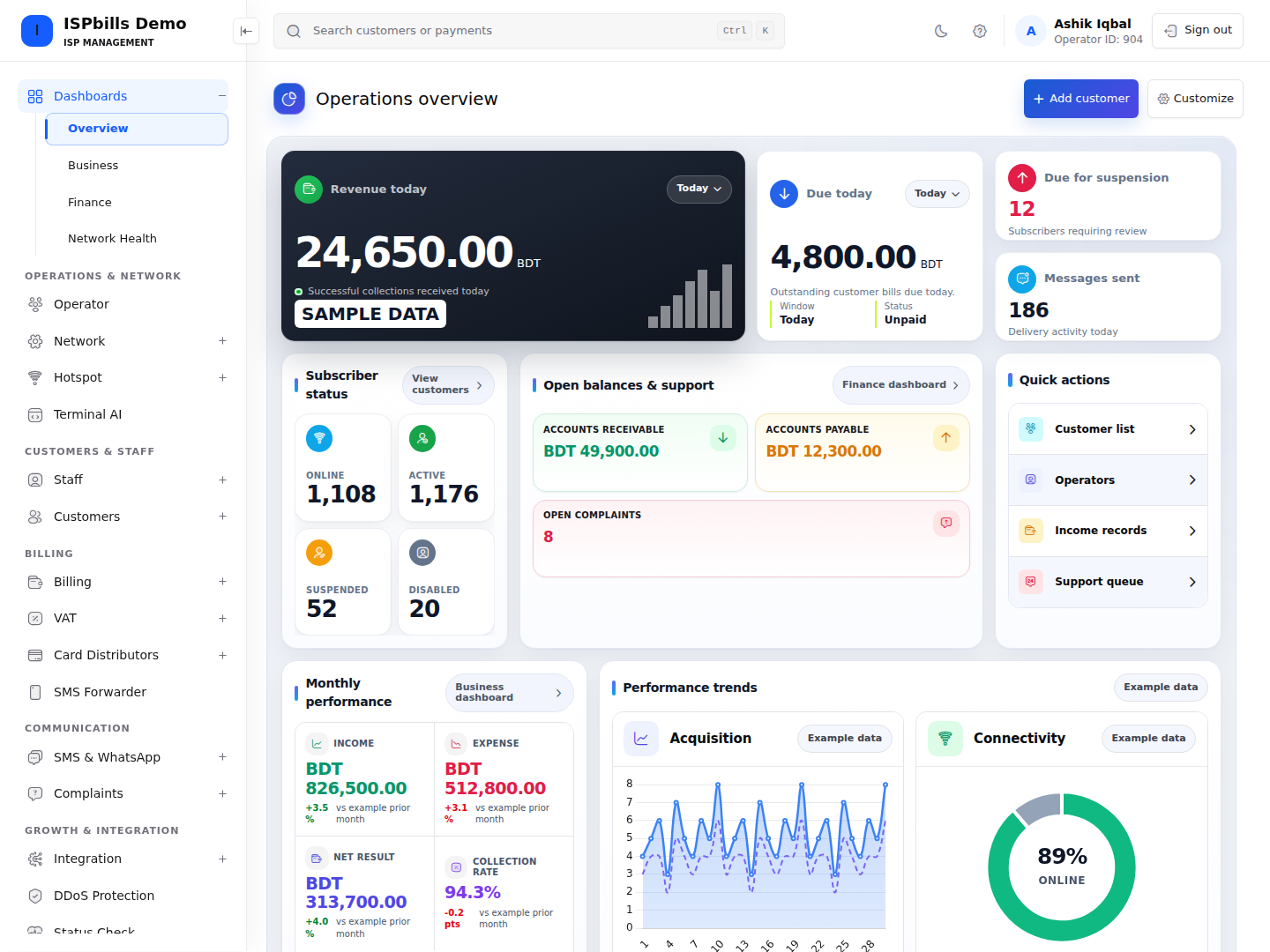
Billing is reliable when every downstream action shares the same subscriber state.
An invoice is only one part of ISP operations. Collections, service activation, package changes, suspension, restoration and support all depend on the same customer and network context. ISPbills keeps those handoffs visible and auditable.
Create the subscriber record
Store identity, service location, package, billing cycle and access credentials in one operational record.
Generate recurring charges
Run prepaid or postpaid billing with invoices, balances, taxes, proration and defined due dates.
Reconcile the payment
Match supported online or staff-recorded payments before changing the commercial balance.
Apply access policy
Coordinate activation, suspension or restoration through the configured RADIUS, PPPoE or device workflow.
Everything this workflow needs—without losing the boundaries.
Capabilities shown here are implemented product areas. Device, provider and protocol behavior still depends on the selected integration and environment.
Billing and collections
Recurring invoices, payment records, receipts, taxes, grace rules and collection reporting.
Subscriber lifecycle
Signup, package assignment, renewal, suspension, restoration and customer self-service.
AAA and sessions
FreeRADIUS authentication, authorization, accounting, NAS records, active sessions and CoA workflows.
Network operations
MikroTik RouterOS, OLT and ONU operations, device status, traffic and incident context.
Teams and resellers
Role-scoped staff, multi-level reseller operations, credits, commissions and accountability.
Integration surface
Regional payments, SMS and messaging providers, REST APIs, webhooks and supported device protocols.
One subscriber state, carried through every team.
The commercial record is useful only when collections, access, support and network teams can act from the same current state—with permissions and an audit path.
Read implementation documentation →Bill and reconcile
Recurring charges, proration, taxes, receipts and balances remain distinct from provider callbacks and access decisions.
Apply service policy
Configured RADIUS, PPPoE or device workflows coordinate activation, suspension and restoration.
Resolve with context
Support sees the package, payment, session, equipment and ticket history without rebuilding the story.
From charge to service state without an invisible handoff.
Invoice generation, payment verification and network access remain separate accountable steps. That separation makes exceptions visible and reduces accidental service changes.
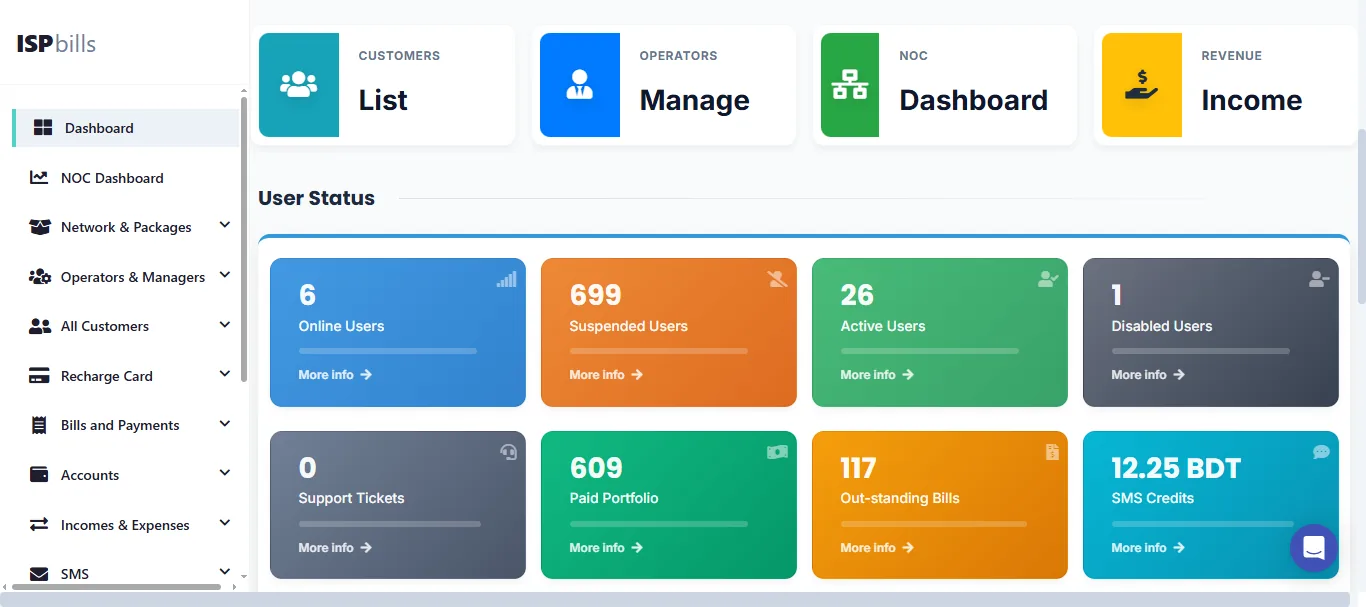
Focused guides for the decisions behind the product.
Choose the deployment model around your operating responsibilities.
Public product information describes the current operating model. A controlled pilot proves the exact fit for your data, devices, providers and failure cases.
- 01Managed cloudISPbills manages the application hosting path; your team remains responsible for network access, business configuration and operational approvals.
- 02Self-hostedRun the supported deployment in infrastructure you control when residency or internal operations require it.
- 03MigrationMap customers, packages, balances, credentials, devices and integrations before a staged and validated cutover.
Straight answers before you deploy.
Need a model-, provider- or migration-specific answer? Bring the exact environment to the team.
What is ISP billing software?
ISP billing software manages subscriber plans, recurring charges, invoices, payments, balances and service status. A connected platform can also coordinate those records with authentication and network systems.
Does ISPbills support prepaid and postpaid billing?
Yes. ISPbills supports prepaid and postpaid operating models, recurring billing, proration, taxes, grace periods and subscriber lifecycle rules.
Can billing control PPPoE or RADIUS access?
Yes, when the required RADIUS, router and policy integrations are configured. Operators should validate the exact suspend, restore and session-control path in a pilot before production rollout.
Can ISPbills be self-hosted?
Yes. ISPbills offers managed cloud and supported self-hosted deployment paths. Backups, updates, monitoring and infrastructure ownership should be agreed during onboarding.
How should an ISP plan migration?
Start with a read-only inventory of subscriber identifiers, packages, balances, invoices, payments, access credentials, devices and integrations. Validate mappings and a rollback plan before cutover.
See how ISPbills fits the network you already run.
Explore the current product, then scope compatibility and migration with your actual devices, billing rules and integrations.