Implementation guide
ISP RADIUS Architecture and Deployment Guide
This technical guide focuses on the architecture behind a central AAA service: multiple access devices, one subscriber-policy source, resilient paths and observable failure behavior. Use the separate ISP RADIUS page for commercial platform evaluation.
Use the interface and documentation together.
The capture below shows the related ISPbills product area. Follow the linked documentation for current fields and prerequisites, then validate the exact device, provider, software version, failure path and rollback before production use.
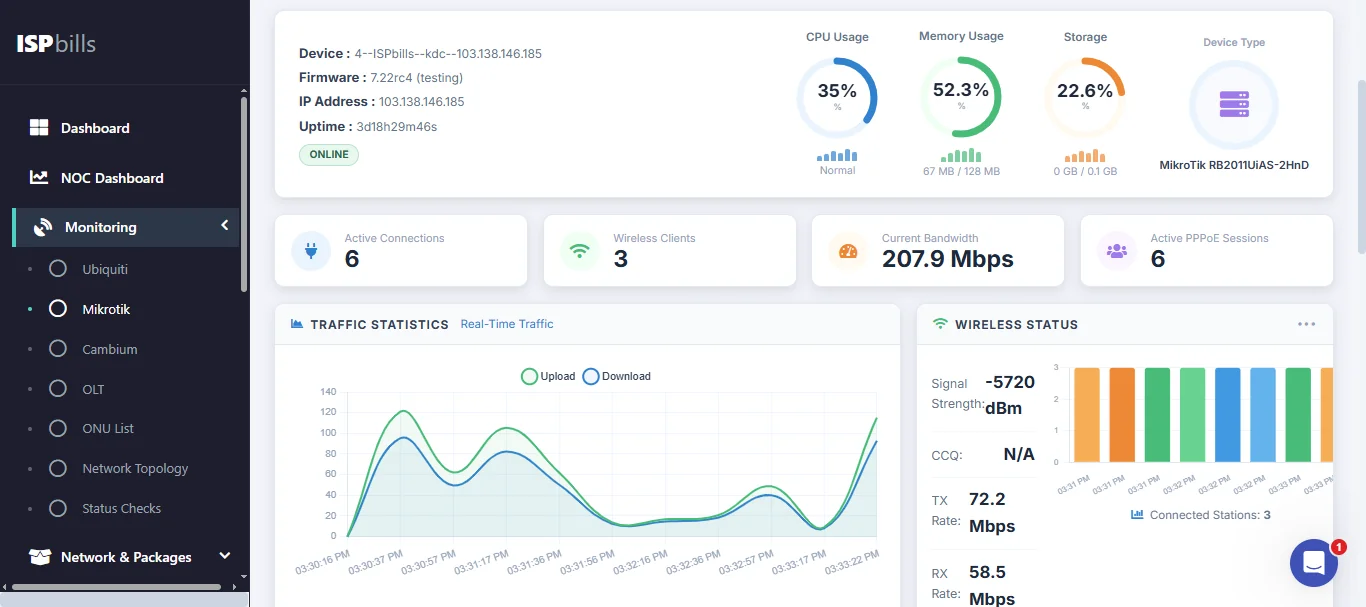
Plan the complete path, not one isolated setting.
Design a centralized ISP RADIUS architecture for authentication, authorization, accounting, NAS policy, redundancy and operational diagnosis. Confirm the exact device, software version, provider contract and failure behavior in a representative environment before production rollout.
Centralize identity
Maintain the intended credential and service-policy source for supported access devices.
Return authorization
Provide plan, session and network attributes appropriate to each subscriber.
Retain accounting
Use start, interim and stop records for support, usage and session investigation.
Prove the boundaries before automating them.
Record expected results, failure signals, the person who can approve a change, and the rollback path. Product support depends on the deployed architecture and integration version.
- Redundancy and failure policyTest this requirement with representative data and retain the result in the implementation plan.
- NAS inventory and secretsTest this requirement with representative data and retain the result in the implementation plan.
- Attribute dictionariesTest this requirement with representative data and retain the result in the implementation plan.
- Logs, retention and privacyTest this requirement with representative data and retain the result in the implementation plan.
Implementation answers
Why use centralized RADIUS?
It avoids maintaining separate credentials and policies independently on every compatible access device.
Can one RADIUS service support multiple routers?
Yes. Each NAS must be registered and the production design must account for reachability, secrets and failure behavior.
Does ISPbills host RADIUS?
Deployment details depend on the selected ISPbills architecture; confirm hosting and network-path responsibilities during onboarding.
Bring the actual routers, access design, billing rules and failure cases.
Explore the online workspace or ask ISPbills to review compatibility and migration scope.