FTTH operations knowledge hub
FTTH ISP Operations: Billing, OLT, ONU & Fiber Workflows
Plan the complete fiber subscriber lifecycle from serviceability and installation through billing, OLT and ONU operations, optical diagnosis, support and retirement. Use each focused page for the commercial or device question it owns.
Inspect the working interface, then verify your exact environment.
This is a real ISPbills product capture, not a conceptual mockup. Interface access depends on role and configuration; integration behavior must be tested with the actual provider, device model, firmware and network path.
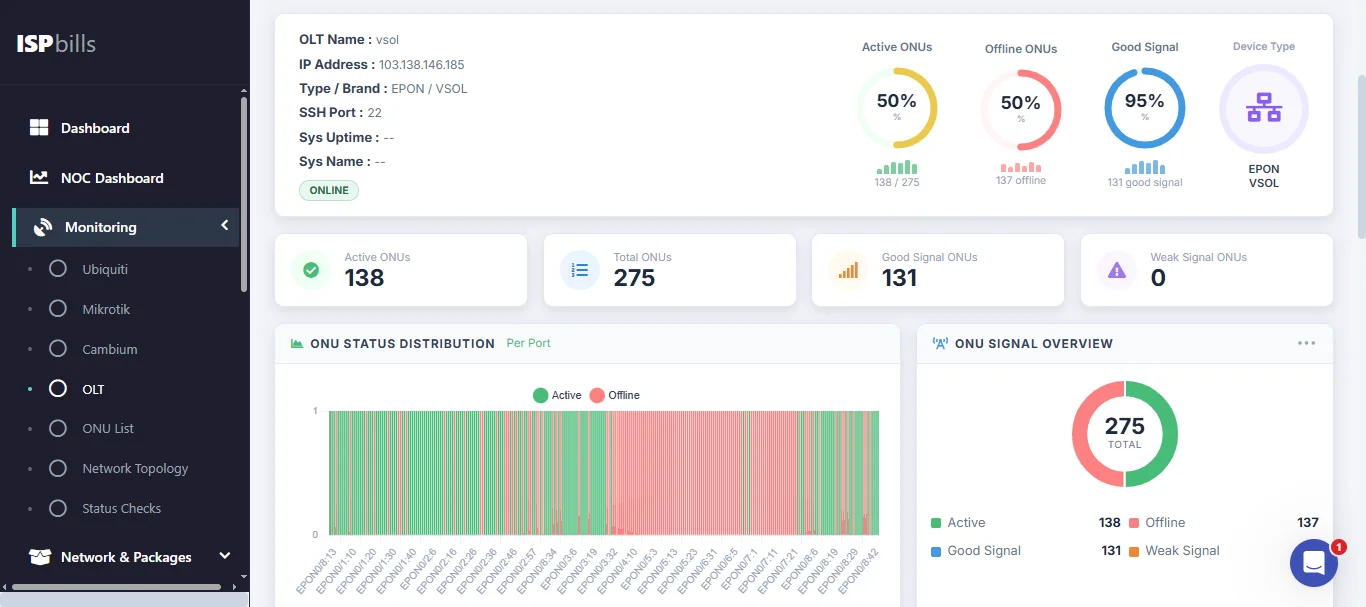
Fiber operations span the customer record and the physical access path.
A billing balance, ONU serial, PON location and optical reading describe different parts of the same service. A useful FTTH operating model links those records while preserving vendor-specific provisioning rules and field ownership.
Plan serviceability
Record locations, access infrastructure, capacity and installation requirements before promising activation.
Provision the endpoint
Associate the intended OLT, PON, ONU and service profile after validating vendor and firmware support.
Bill the service
Keep package, invoice, payment and eligibility state connected to the installed subscriber service.
Operate and support
Use topology, optical, device, customer and incident context to investigate service issues.
Capabilities connected to the operating workflow
Use these as evaluation areas, then confirm the exact device, provider, version and commercial requirements that apply to your deployment.
FTTH billing software
Evaluate recurring billing, payment and access-state workflows for fiber subscribers.
Open comparisonOLT management
Review supported discovery, provisioning, PON and optical workflows.
Open comparisonONU management
Manage endpoint identity, association, signal context and lifecycle boundaries.
Open comparisonFTTH solution
See the end-to-end subscriber and team operating model for fiber providers.
Open comparisonNetwork monitoring
Connect fiber alarms and device state to subscriber impact and incident work.
Open comparisonCustomer management
Keep installation, package, equipment, billing and support context together.
Open comparisonExplore this topic in depth
Each page owns a distinct search and implementation question, with direct links into current documentation.
FTTH Billing Software with OLT and ONU Operations
Connect FTTH subscriber billing, payment, service status, OLT and ONU provisioning, optical diagnostics, GIS and support workflows.
Read focused guideCompatibility must be proven at vendor, model, firmware and action level.
Confirm the current product behavior in a representative environment. Public pages describe the operating model; implementation documentation and a controlled pilot establish the exact fit.
- InventoryRecord every OLT and ONU vendor, model, firmware, board, PON and management protocol used by the pilot.
- Action matrixSeparate readable telemetry from supported write actions such as authorization, profile assignment or reboot.
- Field verificationConfirm physical labeling, customer association, optical thresholds and rollback with the field team.
Product, evidence and implementation paths
Answers for evaluation and implementation
What is FTTH management software?
It connects fiber subscriber, service, billing, OLT, ONU, monitoring and support workflows while retaining equipment-specific boundaries.
Does every OLT support the same actions?
No. Discovery, telemetry and configuration depend on vendor, model, firmware, protocol and the available ISPbills driver.
How should an FTTH integration be piloted?
Use representative OLTs, ONUs, profiles, optical conditions, billing states and field handoffs with documented acceptance and rollback criteria.
Bring the devices, billing rules and integrations your ISP actually uses.
Use the online workspace for product exploration, or ask the team to scope migration and compatibility questions.