Implementation guide
MikroTik RouterOS API Integration for ISP Billing
The RouterOS API can configure and inspect a device, but access must be scoped and observable. ISPbills uses saved device connections for supported actions while operators retain approval and rollback responsibility.
Use the interface and documentation together.
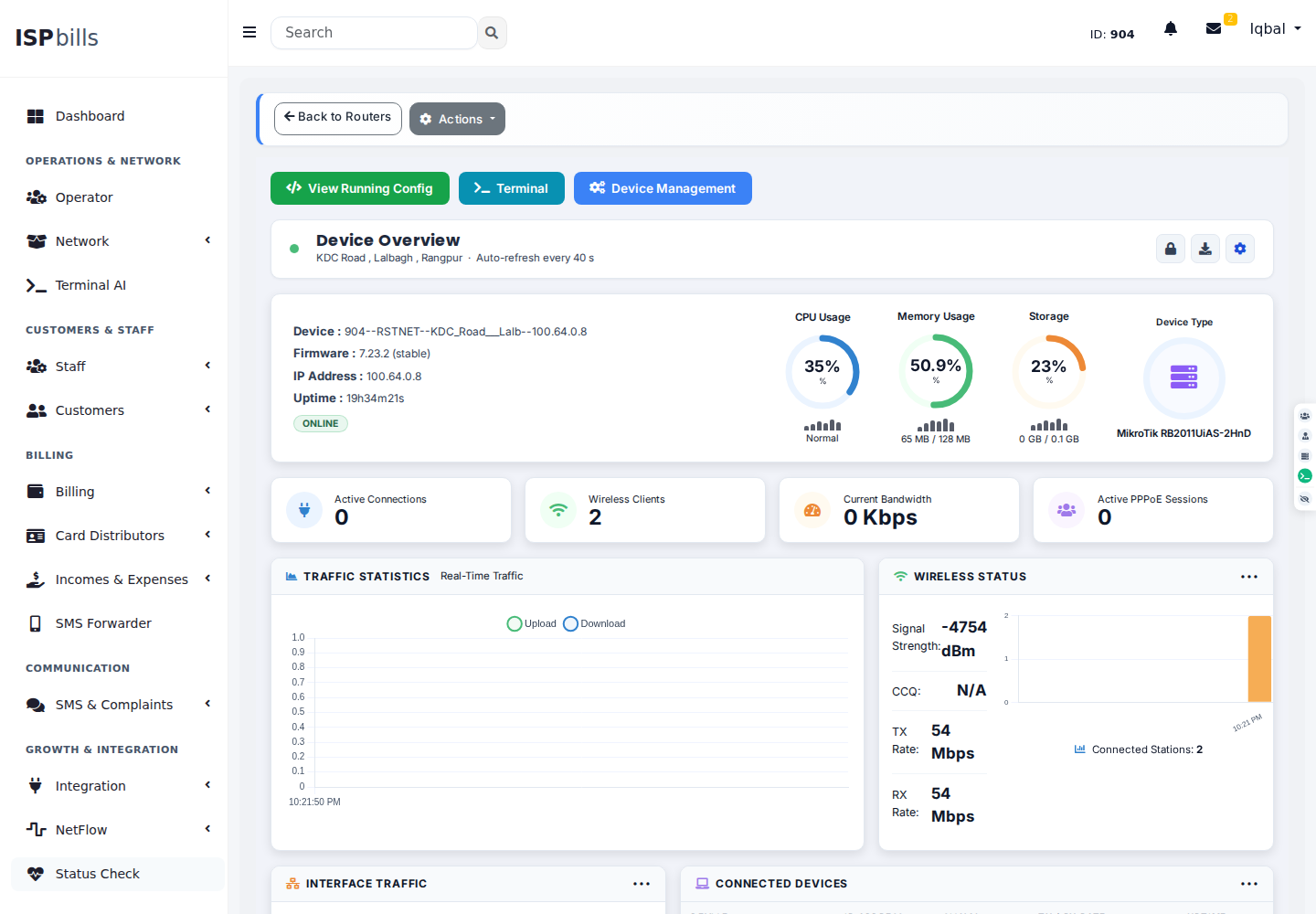
The capture below shows the related ISPbills product area. Follow the linked documentation for current fields and prerequisites, then validate the exact device, provider, software version, failure path and rollback before production use.
Plan the complete path, not one isolated setting.
Connect RouterOS API operations to ISP billing with scoped credentials, private management paths, validation, audit history and rollback planning. Confirm the exact device, software version, provider contract and failure behavior in a representative environment before production rollout.
Secure connectivity
Use a trusted management route, restricted source access and the minimum required RouterOS permissions.
Verify capabilities
Test every required read and write operation against the actual RouterOS release.
Control changes
Separate monitoring from configuration and retain operator, target, result and failure context.
Prove the boundaries before automating them.
Record expected results, failure signals, the person who can approve a change, and the rollback path. Product support depends on the deployed architecture and integration version.
- TLS or private transportTest this requirement with representative data and retain the result in the implementation plan.
- Least-privilege RouterOS groupTest this requirement with representative data and retain the result in the implementation plan.
- Timeout and retry behaviorTest this requirement with representative data and retain the result in the implementation plan.
- Configuration backup and rollbackTest this requirement with representative data and retain the result in the implementation plan.
Implementation answers
Which RouterOS API port is used?
RouterOS commonly exposes API on 8728 and API-SSL on 8729, but the secured deployment configuration is authoritative.
Should the API be exposed publicly?
Prefer a private or tightly restricted management path and limit source addresses and credentials.
Does the API replace RADIUS?
No. The API manages supported device operations; RADIUS provides centralized AAA. They solve different problems.
Bring the actual routers, access design, billing rules and failure cases.
Explore the online workspace or ask ISPbills to review compatibility and migration scope.