Implementation guide
MikroTik PPPoE Billing and Subscriber Automation
A dependable PPPoE workflow keeps the billing account, credential, service profile and active session aligned. The design should make failure and rollback behavior explicit before automation reaches production.
Use the interface and documentation together.
The capture below shows the related ISPbills product area. Follow the linked documentation for current fields and prerequisites, then validate the exact device, provider, software version, failure path and rollback before production use.
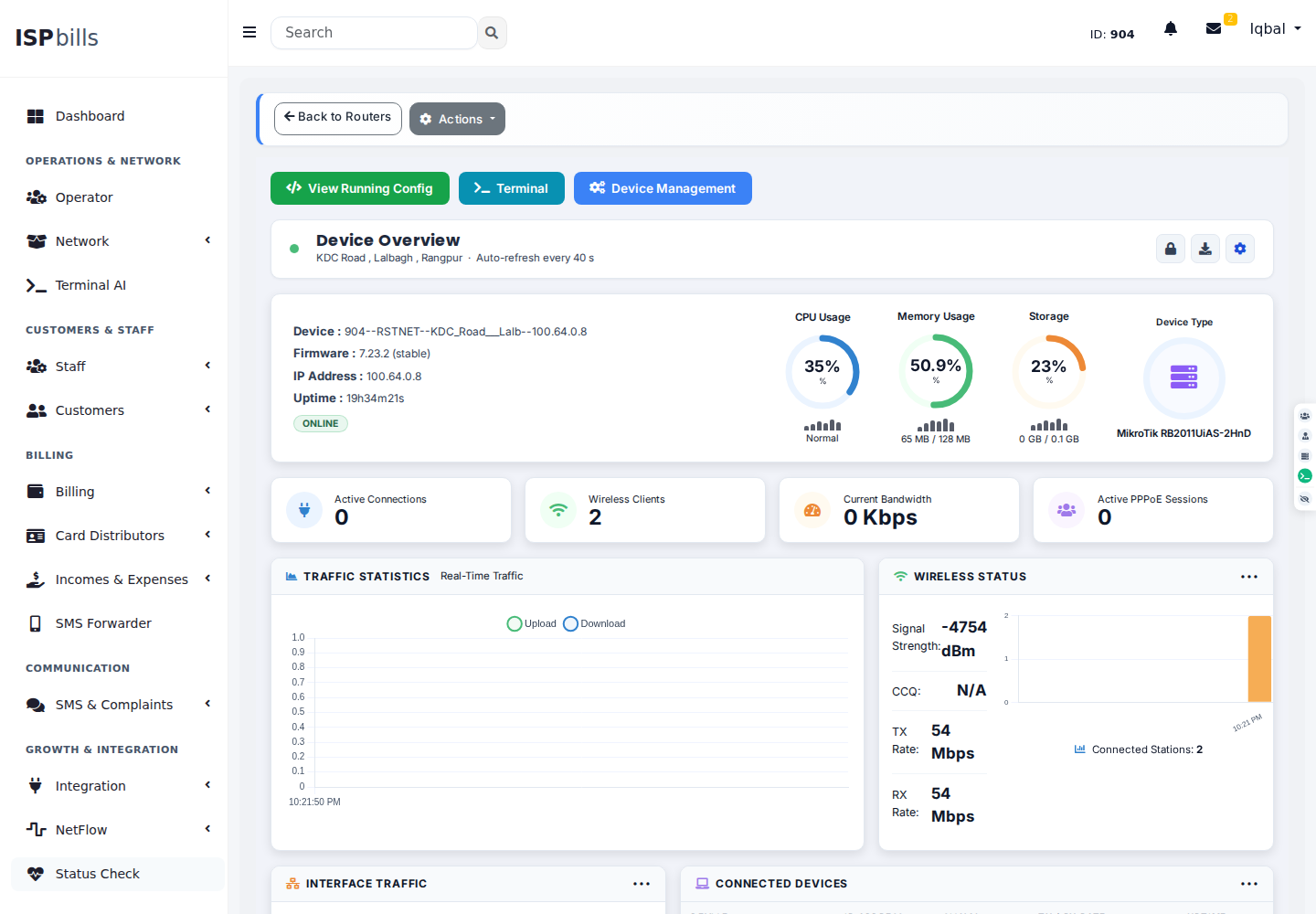
Plan the complete path, not one isolated setting.
Design MikroTik PPPoE billing around subscriber identity, packages, RADIUS or RouterOS, session state, expiry, suspension and reconnection. Confirm the exact device, software version, provider contract and failure behavior in a representative environment before production rollout.
Choose credential ownership
Decide whether PPP secrets live on RouterOS or are evaluated centrally through FreeRADIUS.
Map package policy
Associate speed, pools, session limits and billing rules with a stable subscriber record.
Test lifecycle changes
Verify signup, renewal, package change, expiry, suspension and reconnection with representative sessions.
Prove the boundaries before automating them.
Record expected results, failure signals, the person who can approve a change, and the rollback path. Product support depends on the deployed architecture and integration version.
- Username normalization and duplicatesTest this requirement with representative data and retain the result in the implementation plan.
- RADIUS attributes or PPP profilesTest this requirement with representative data and retain the result in the implementation plan.
- Active-session behavior on expiryTest this requirement with representative data and retain the result in the implementation plan.
- Accounting and clock synchronizationTest this requirement with representative data and retain the result in the implementation plan.
Implementation answers
Should PPPoE use RouterOS secrets or RADIUS?
Either can be valid. Use RouterOS for direct device ownership or RADIUS for centralized AAA; choose based on resilience, scale and policy needs.
Can a package change update speed?
Yes, through the configured profile, attribute or queue workflow. Verify whether the current session must be changed or reconnected.
How should expired sessions be handled?
Define grace, notification, disconnect and restoration behavior explicitly and test it before automatic enforcement.
Bring the actual routers, access design, billing rules and failure cases.
Explore the online workspace or ask ISPbills to review compatibility and migration scope.