Implementation guide
MikroTik IPv6 Subscriber Provisioning for ISPs
IPv6 provisioning is not an IPv4 address field made longer. Prefix ownership, delegation, route behavior, subscriber identity and dual-stack support need an explicit operating model.
Use the interface and documentation together.
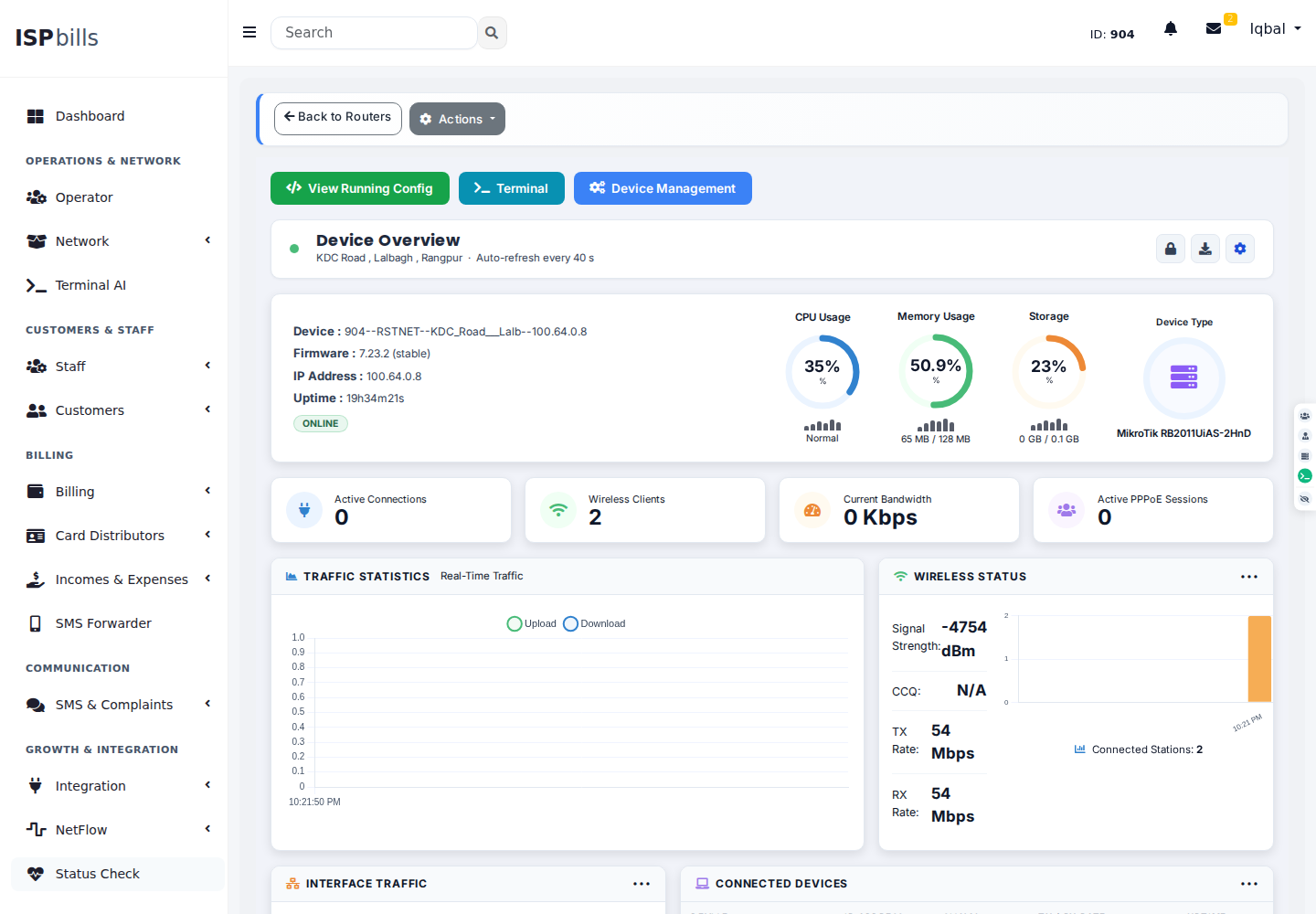
The capture below shows the related ISPbills product area. Follow the linked documentation for current fields and prerequisites, then validate the exact device, provider, software version, failure path and rollback before production use.
Plan the complete path, not one isolated setting.
Plan MikroTik IPv6 subscriber services with prefixes, pools, RouterOS policy, RADIUS attributes, accounting and dual-stack support workflows. Confirm the exact device, software version, provider contract and failure behavior in a representative environment before production rollout.
Plan address ownership
Document aggregate prefixes, pools, delegated-prefix sizes and assignment stability.
Map access policy
Validate RouterOS and RADIUS attributes for the chosen PPPoE, DHCPv6 or routed design.
Test dual stack
Verify routing, DNS, accounting, suspension, support visibility and customer-premises behavior.
Prove the boundaries before automating them.
Record expected results, failure signals, the person who can approve a change, and the rollback path. Product support depends on the deployed architecture and integration version.
- Prefix delegation sizeTest this requirement with representative data and retain the result in the implementation plan.
- Router advertisements and DHCPv6Test this requirement with representative data and retain the result in the implementation plan.
- RADIUS vendor attributesTest this requirement with representative data and retain the result in the implementation plan.
- Accounting and abuse traceabilityTest this requirement with representative data and retain the result in the implementation plan.
Implementation answers
Does IPv6 use the same pool as IPv4?
No. IPv6 addressing and delegated prefixes require their own allocation and routing design.
Can RADIUS return IPv6 policy?
Compatible NAS devices can consume standard or vendor-specific IPv6 attributes; validate the exact RouterOS behavior.
Should ISPs deploy dual stack first?
Many operators do, but the correct transition depends on upstream routing, CPE support, DNS and support readiness.
Bring the actual routers, access design, billing rules and failure cases.
Explore the online workspace or ask ISPbills to review compatibility and migration scope.